
 England
 Scotland
 Wales
 USA
 France
 Germany
 Spain
 Italy
 Australia
 European Union
 Confederate
 Rainbow
 Other Pride
 Red Ensign
 RAF Ensign
 Yorkshire
 Cornwall
 Union Jack
 Ireland
Estonia Flags – Estonian Flag, Bunting & Hand Flags
Blue, black and white, the sinimustvalge, for Independence Day on 24 February, Victory Day on 23 June and the Song Festival year. Buy the Estonian flag in 20x12in to 8ft x 5ft, run Estonia bunting along the Estonian House stairs and wave Estonia hand flags at the Jaanipäev bonfire.
 Estonia Flagfrom £6.99
-
Estonia Flag
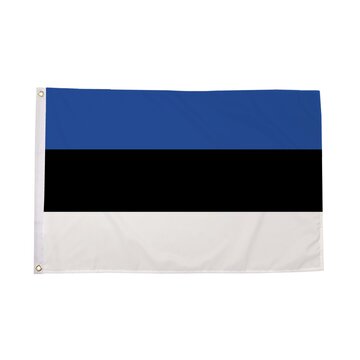 Choose size →5 sizes · 2 qualities · 3 fittingsThe price depends on the options chosen on the product pagefromAs low as £6.98

Shop Estonia in every format
The Estonian flag: blue, black and white
Estonia’s flag, the sinimustvalge, is a horizontal tricolour of blue, black and white in equal bands. It began as the colours of the Estonian Students’ Society at Tartu, which chose them in 1881 and consecrated its first flag at Otepää on 4 June 1884, and it passed from the student movement to the national awakening and then to the state, becoming the national flag on the declaration of independence in 1918 and being confirmed in law in 1922. Under Soviet occupation it was banned, and raising it was an act of resistance; it flew again from the Pikk Hermann tower in Tallinn on 24 February 1989 and was restored as the state flag in 1990. The most common reading is blue for the sky, the lakes and the sea, black for the soil and the dark past, white for the snow, the summer nights and the hope of a brighter future. The ratio is 7:11. Our Estonia flag uses the specified mid-blue rather than a navy, which is the usual error on imported flags.
24 February, Victory Day and the Song Festival
Independence Day on 24 February, when the flag is raised at sunrise on Toompea, is the first of the flag days; 4 June is Flag Day itself, marking the 1884 consecration; 23 June is Victory Day and runs into Jaanipäev, the midsummer bonfires; and 20 August is the Day of Restoration of Independence. Estonians in Britain are a small community with a long history, centred on the Estonian House in London, with a parish, a school and 24 February dinners, and newer arrivals in the tech and shipping trades. The Laulupidu song and dance festival in Tallinn every five years, which draws expatriates home in their thousands, is the other great display of the colours. In sport the flag flies for Estonia’s cross-country skiers, the wrestlers and discus throwers who have won most of the country’s Olympic medals, the rally drivers Ott Tänak and Markko Märtin, and, closer to home, Ragnar Klavan’s spell at Liverpool and the national football team’s visits to Wembley.
Choosing an Estonia flag
The Estonia flag is stocked in 20x12in, 3ft x 2ft, 5ft x 3ft and 8ft x 5ft and in two grades. Flagtex is the printed woven polyester, light and economical, for a dinner, a classroom or a season on a pole; DuraFlag is the knitted heavyweight with a double-stitched edge for a pole flown through the winter. 5ft x 3ft is the garden pole size, 3ft x 2ft the window or wall bracket, 8ft x 5ft the stage or large fixed pole, 20x12in the car or hand pole. Both have a sewn header and brass eyelets; the DuraFlag may be ordered with clips or a rope and toggle.
Estonia bunting
Estonia bunting is sold in 3m and 9m lengths of rectangular pennants in the tricolour, sewn to a tape. 3m suits a doorway or a table for a 24 February evening; 9m runs round a hall, a sauna terrace for Jaanipäev or a classroom. It is weatherproof polyester, so it can stay out overnight, and lengths join end to end. Plain blue, black and white lengths from the bunting range match the colours.
Hand flags and table flags
Estonia hand flags on wooden sticks come in 9x6in and 18x12in for parades, a song festival viewing and the football. The Estonia table flag is a 6x4in flag on a base for an office, the 9x6in wooden table flag and the 18x12in large wooden table flag suit a reception, and the sleeved satin table flag is for a formal table. Latvia, Lithuania, Finland and Sweden are under world flags.
Estonian flag FAQs
What do the colours of the Estonian flag mean?
Blue for the sky, sea and lakes, black for the soil of the homeland and the hardships of the past, white for snow, light and the hope of a better future.
Where did the Estonia flag come from?
From the Estonian Students’ Society in Tartu, which adopted the colours in 1881 and consecrated its first flag on 4 June 1884. It became the national flag in 1918.
When is Estonia’s Independence Day?
24 February, the anniversary of the 1918 declaration. 20 August marks the restoration of independence in 1991 and 4 June is Flag Day.
Which way up does the Estonian flag go?
Blue at the top, black in the middle, white at the bottom.
Is there a vertical version of the Estonian flag?
Hung vertically the blue band goes on the left as viewed. The stocked flag is the horizontal format and can be turned on its eyelets.
What size Estonia flag for a house pole?
5ft x 3ft on a 6m telescopic pole; 3ft x 2ft on a wall bracket; 8ft x 5ft on a 20ft fixed pole or as a backdrop.
How quickly can an Estonia flag be delivered?
Every size, the bunting and the hand flags are stocked in and dispatched from our Stoke-on-Trent warehouse, same day when ordered before 2pm, with 1–2 day UK delivery.