
 England
 Scotland
 Wales
 USA
 France
 Germany
 Spain
 Italy
 Australia
 European Union
 Confederate
 Rainbow
 Other Pride
 Red Ensign
 RAF Ensign
 Yorkshire
 Cornwall
 Union Jack
 Ireland
Eswatini Flags – Swaziland Flag, Bunting & Hand Flags
The black and white Nguni shield and spears on crimson, blue and gold, flown for Independence Day on 6 September, the Umhlanga reed dance and Swazi community events in the UK. Eswatini (formerly Swaziland): order the Eswatini flag in 20x12in to 8ft x 5ft, add Eswatini bunting in 3m or 9m and share Eswatini hand flags.
 Eswatini Flagfrom £6.99
-
Swaziland Flag
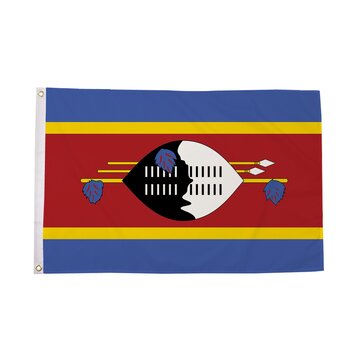 Choose size →4 sizes · 2 qualities · 3 fittingsThe price depends on the options chosen on the product pagefromAs low as £6.98
-
Swaziland Bunting
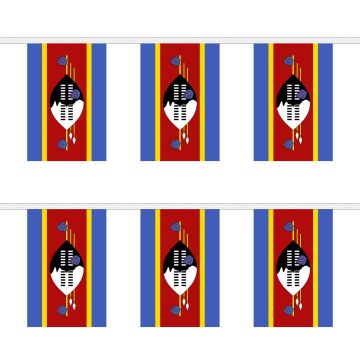 Choose length →2 lengthsThe price depends on the options chosen on the product pagefromAs low as £9.98
-
Swaziland Hand Flags
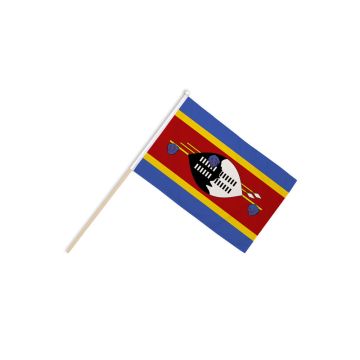 Choose size →2 sizesThe price depends on the options chosen on the product pagefromAs low as £5.99
-
Swaziland Table Flag
 Choose options →Multiple optionsThe price depends on the options chosen on the product pagefrom
From £5.99
To £6.98
-
Swaziland Wooden Table Flag
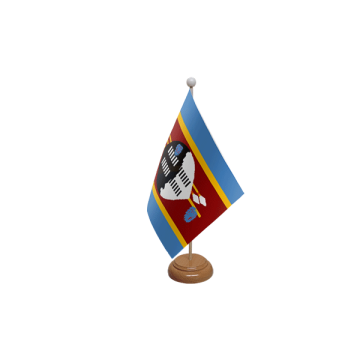 Choose options →Multiple optionsThe price depends on the options chosen on the product pagefrom
From £5.99
To £7.99
-
Swaziland Large Wooden Table Flag
Choose options →Multiple optionsThe price depends on the options chosen on the product pagefrom
From £7.99
To £10.99
-
Swaziland Satin Table Flag
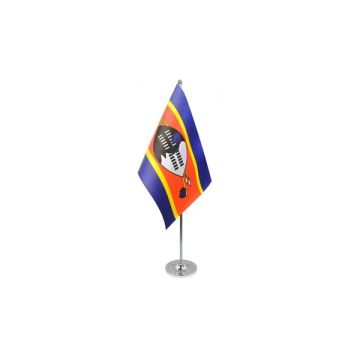 Choose options →Multiple optionsThe price depends on the options chosen on the product pagefrom
From £5.99
To £15.99


Shop Swaziland in every format
The Eswatini flag: the Nguni shield on crimson
Eswatini, formerly Swaziland, flies one of the most distinctive flags in Africa. It has five horizontal bands, blue, yellow, a wide crimson centre, yellow and blue, and across the crimson lies a black-and-white Nguni shield of oxhide laid over two spears and a staff decorated with tassels of feathers from the widowbird and the lourie, both birds associated with the monarchy. Crimson recalls past battles, blue stands for peace and stability, and yellow for the country’s mineral wealth. The black and white of the shield are said to show black and white people living together in peace. The design is based on a military banner given by King Sobhuza II to the Swazi Pioneer Corps in 1941 and was adopted on 6 October 1968, shortly after independence. In 2018 King Mswati III renamed the country Eswatini, meaning “land of the Swazis”, but the flag did not change. Our catalogue still lists it as the Swaziland flag; it is the current Eswatini national flag.
Independence Day, Umhlanga and the Swazi community
Eswatini became independent from Britain on 6 September 1968, and Somhlolo Day, as Independence Day is also called, is the main national holiday. The two great cultural ceremonies are Umhlanga, the reed dance held in late August or early September, and Incwala, the kingship ceremony around the December and January solstice, both of which feature the flag alongside traditional dress. The Sihlangu Semnikati football team and the country’s runners and boxers carry it at the Commonwealth Games and the Olympics. The Swazi community in the UK is small but close-knit, gathering for independence celebrations, church services and charity events, and the flag is regularly ordered for school projects, Commonwealth Day displays, gap-year and mission links, and the Southern African societies at British universities.
Sizes, grades and fittings
The Eswatini flag is stocked in 20x12in, 3ft x 2ft, 5ft x 3ft and 8ft x 5ft. Flagtex is a printed lightweight polyester for indoor display and short events; DuraFlag is a thicker knitted polyester with stronger hems for a pole outdoors. Brass eyelets come as standard, with clips or rope and toggle available on DuraFlag.
Eswatini bunting
Eswatini bunting places the shield-and-spears flag on rectangular pennants in 3m and 9m lengths, ready for a hall, a classroom or a Commonwealth Day display. It is printed on both sides on polyester that can go outside.
Hand flags and table flags
Eswatini hand flags on wooden sticks come in 9x6in and 18x12in for school parades and independence gatherings. The Eswatini table flag is 6x4in with a base, and the large wooden table flag at 18x12in suits a top table or reception. South Africa, Lesotho, Mozambique and Botswana are in world flags.
Eswatini flag FAQs
Is Swaziland the same as Eswatini?
Yes. The country was renamed Eswatini in April 2018, the fiftieth anniversary of independence. The flag stayed the same, so a Swaziland flag is the Eswatini flag.
What is on the Eswatini flag?
A Nguni oxhide shield over two spears and a staff with feather tassels, on a crimson band edged with yellow and blue.
What do the colours of the Eswatini flag mean?
Crimson for past battles, blue for peace and stability, and yellow for the country’s resources; the black and white shield for peaceful coexistence.
When was the Eswatini flag adopted?
6 October 1968, a month after independence from Britain on 6 September 1968.
What is the Umhlanga reed dance?
An annual ceremony in late August or early September when thousands of young women bring reeds to the Queen Mother’s royal residence.
Why is the product called Swaziland in your shop?
The product names date from before the 2018 renaming; the flag you receive is the current national flag of Eswatini.
How quickly can I get an Eswatini flag?
Our Eswatini range is stocked in and dispatched from our Stoke-on-Trent warehouse; place your order by 2pm for dispatch that day and free UK delivery in 1–2 working days.