
 England
 Scotland
 Wales
 USA
 France
 Germany
 Spain
 Italy
 Australia
 European Union
 Confederate
 Rainbow
 Other Pride
 Red Ensign
 RAF Ensign
 Yorkshire
 Cornwall
 Union Jack
 Ireland
European Union Flags – EU Flag, Bunting & Hand Flags
The EU flag, twelve gold stars in a circle on blue, for Europe Day on 9 May, Eurovision parties, pro-European marches, language schools, hotels and businesses that trade across the Channel. Fly the European Union flag in 20x12in to 8ft x 5ft, hang EU bunting up to 20m, and add the 27 nations flag showing every member state.
 European Union (EU) Flagfrom £6.99
-
European Union (EU) Table Flag
 Choose options →Multiple optionsThe price depends on the options chosen on the product pagefrom
From £5.99
To £6.98
-
European Union (EU) Bunting
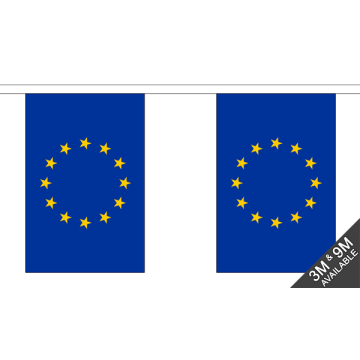 Choose length →4 lengths · 2 qualitiesThe price depends on the options chosen on the product pagefromAs low as £9.98
-
European Union (EU) Wooden Table Flag
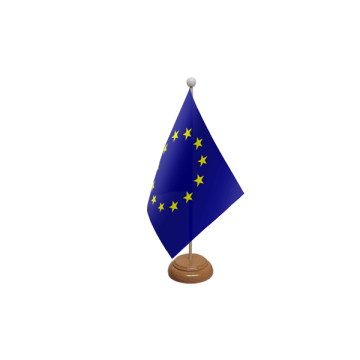 Choose options →Multiple optionsThe price depends on the options chosen on the product pagefrom
From £5.99
To £7.99
-
European Union (EU) Large Wooden Table Flag
Choose options →Multiple optionsThe price depends on the options chosen on the product pagefrom
From £7.99
To £10.99
-
European Union (EU) Satin Table Flag
 Choose options →Multiple optionsThe price depends on the options chosen on the product pagefrom
From £5.99
To £15.99
-
EU and USA Alternating Bunting
 Choose length →2 lengthsThe price depends on the options chosen on the product pagefromAs low as £9.98


Shop European Union in every format
The EU flag: twelve gold stars on blue
The European Union flag is a circle of twelve five-pointed gold stars on a deep blue field. It was designed by Arsène Heitz and Paul Lévy and adopted by the Council of Europe on 8 December 1955, long before the EU existed; the European Communities took it up in 1985 and it has flown over the institutions in Brussels, Strasbourg and Luxembourg ever since. The twelve stars have never counted the member states. Twelve was chosen as a symbol of completeness and harmony, the number of months, hours on a clock face and signs of the zodiac, and the circle stands for unity among the peoples of Europe, which is why the count stayed at twelve through every enlargement from six members to twenty-eight and back to twenty-seven. The proportion is 2:3. Our European Union flag uses the specified reflex blue and a stars-up orientation, with one point of every star pointing straight up as the official geometry requires.
Europe Day, Eurovision and the pro-European crowd
Europe Day on 9 May, the anniversary of the Schuman Declaration of 1950, is the fixed date, marked by universities, language schools, twinning associations and the European Movement branches that still fly the flag in towns across Britain. Beyond that the EU flag turns up at Eurovision parties in May, at pro-European marches and rejoin rallies, outside hotels and conference venues that fly the flags of their guests, at ports and freight yards, on Erasmus and student-exchange welcome days, and in classrooms for geography and modern-languages projects. Businesses exporting to the continent fly it beside the Union Jack at trade shows, and plenty of households keep one on the garden pole as a quiet statement.
The 27 nations flag and the EU-USA bunting
The Euro 27 Nations flag shows the flag of every current member state arranged around the stars, the one for a classroom wall, a Europe Day display or a quiz night, and the Euro 25 Nations flag is the earlier version from the 2004 enlargement for anyone matching an existing set. The EU and USA alternating bunting switches between the two flags along the tape for transatlantic conferences, hotel lobbies and business receptions.
Sizes, grades and fittings
The EU flag is held in 20x12in, 3ft x 2ft, 5ft x 3ft and 8ft x 5ft. Flagtex is the woven-polyester print for a march, a party or an indoor hall; Flagtex Nylon is the lighter cloth that flies in a gentle breeze on a hotel forecourt; DuraFlag is the heavy knitted grade with double-stitched hems for a pole that flies the stars all year outside a school, a port office or a council building. Eyelets are standard, with clips or a rope and toggle available on the DuraFlag to match the halyard on a commercial pole.
EU bunting
European Union bunting shows the full circle of stars on every pennant in 3m, 5m, 9m and 20m lengths, in a rectangle or a triangle cut, sewn to a strong tape. A 3m length hangs over a reception desk, 9m lines a classroom or a cafe window for Europe Day, and 20m crosses a street or a marquee for a twinning weekend. Match it with the bunting of individual member states for a multi-nation run.
Hand flags, table flags and windsock
EU hand flags on wooden sticks in 9x6in and 18x12in are the march and the school-assembly flags, sold singly and in packs. The EU table flag with base is the 6x4in desk flag for a conference table, a language school reception or a twinning dinner, and the EU satin table flag on a chrome base is the smarter choice for an office or a hotel desk. The EU windsock suits a campsite, a yacht or a festival pitch. Each member state has its own flag hub under world flags.
EU flag FAQs
Why does the EU flag have twelve stars?
Twelve was chosen in 1955 as a symbol of perfection, completeness and unity, not as a count of members. The number has never changed, whether the Union had six members or twenty-eight.
Who designed the European flag?
Arsène Heitz, a Strasbourg artist, and Paul Lévy of the Council of Europe. The Council adopted it on 8 December 1955 and the European Communities took it as their emblem in 1985.
Is the EU flag the same as the Council of Europe flag?
Yes. The Council of Europe, which has 46 member states including the UK, created the flag and still uses it. The EU adopted the same design in 1985, so the flag represents both organisations.
When is Europe Day?
9 May, the anniversary of Robert Schuman’s 1950 declaration that led to the European Coal and Steel Community. The Council of Europe keeps a separate Europe Day on 5 May.
Which way up do the stars go?
Every star should have one point facing straight up, like a star on a Christmas tree, and the circle should sit centred on the flag. Our flags are printed to that specification.
Can I still buy an EU flag in the UK?
Of course. The EU flag, bunting, hand flags and table flags are all stocked in and dispatched from our Stoke-on-Trent warehouse, same day on orders placed before 2pm, with free 1–2 day delivery.
What is the Euro 27 Nations flag?
A flag showing the national flags of all 27 member states together with the EU stars, used for classrooms, Europe Day displays and events. The Euro 25 Nations version shows the membership as it stood after the 2004 enlargement.