European Union
 Confederate
 Rainbow
 Other Pride
 Red Ensign
 RAF Ensign
 Yorkshire
 Cornwall
 Union Jack
 England
 Scotland
 Wales
 USA
 Ireland
 France
 Germany
 Italy
 Australia

A yacht burgee is a small flag, usually triangular, that shows which sailing or yacht club the owner belongs to. Traditionally it flies at the top of the main mast, although many boats now fly it from the starboard spreader. Etiquette says only one burgee at a time, and the burgee belongs to the member, not the boat. This guide explains what burgees mean and how they differ from private signals and pennants. It also covers where and when to fly one, what size to choose, and how to design a burgee your club will be proud of.
What is a yacht burgee?
The burgee is a club membership flag. The design is set by the club, and a member flies it while they are aboard and in charge of the boat. It tells other sailors, harbour masters and fellow members which club you sail with, and in a strange harbour it often starts a conversation.
Most club burgees are triangular, tapering from the hoist (the edge next to the mast or staff) to a point at the fly. Some clubs use a swallow-tailed burgee instead, with a V cut into the fly end. Designs are kept deliberately simple, often a cross, a star, a crown or a club badge on one or two colours, because they have to be recognisable at a distance on a flag that may be only 30cm long.
Burgees grew out of the private signals that nineteenth-century owners flew at the masthead to identify their yachts. As clubs formed, a shared club flag became the main way to show who you sailed with. Today most UK sailing clubs, from Royal clubs with Admiralty warrants to small dinghy clubs, have a burgee of their own.
Burgee, private signal, pennant or house flag?
Several small flags look similar on a mast. The table below sets out the main types a British yacht might fly.
| Flag | Usual shape | Where it is flown | Who may fly it |
|---|---|---|---|
| Club burgee | Triangle (sometimes swallow-tailed) | Main masthead, or the starboard spreader | A member of the club, while aboard and in charge |
| Flag officer's burgee | Swallow-tailed version of the club burgee, sometimes with balls | In place of the club burgee | The commodore, vice-commodore and rear-commodore while in office |
| Private signal | Usually swallow-tailed, sometimes rectangular or triangular | Customs vary: at the masthead in place of a burgee, or on the starboard rigging | The owner (it is their personal flag) |
| House flag | Usually a small rectangle | Port spreader | Members of an organisation such as the RYA, the RNLI or a cruising association |
| Long pennant (vimpel) | Very long and narrow, tapering | Masthead or a shore flagpole | Anyone. It is a decorative or identity flag rather than a club flag |
| Ensign | Rectangle | Stern, or the backstay or gaff | Most British boats fly the Red Ensign. Special ensigns are flown only by warrant |
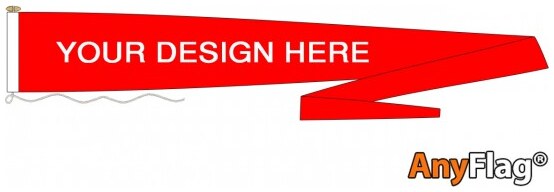
A private signal is the owner's own flag, often based on a family crest, initials or colours. Practice differs between clubs and countries. Many British sailors fly it at the masthead only when they are not flying a club burgee, so if your club has rules, follow them. The vimpel is the long pennant seen on Scandinavian flagpoles and boats. It is not a burgee, but it is a popular way to fly club or boat colours from a garden or clubhouse pole.
Flag officers' burgees
A club's flag officers usually fly a distinguishing version of the club burgee. The most common British pattern is a swallow-tailed burgee for the commodore. The vice-commodore's has one ball (a disc) in the hoist and the rear-commodore's has two. Clubs differ, though. Some use colour changes instead of balls, and past commodores or the club's admiral may have their own flags. The club's own flag rules always take priority.
How to fly a yacht burgee
At the masthead or the starboard spreader?
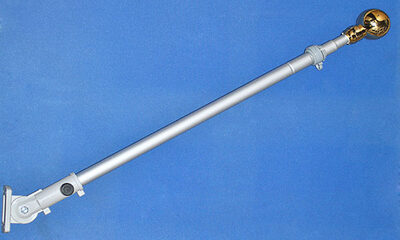
The traditional position is the main masthead, on a short staff (often called a burgee stick or pig stick) hoisted on a halyard so the burgee clears the top of the mast and turns freely in the wind. A masthead burgee also works as a simple wind indicator.
Modern masts carry aerials, wind instruments and lights, so many yachts now fly the burgee from a halyard under the starboard spreader instead. The RYA notes this is common but has traditionally discouraged it, because the starboard spreader is the place for courtesy and signal flags. Most clubs accept the spreader position, but a few, notably some of the senior Royal clubs, still expect the masthead. When you are abroad and a courtesy flag needs the starboard spreader, the burgee usually moves to the port spreader. The courtesy flags guide explains that arrangement.
The basic rules
- One burgee at a time. If you belong to two clubs, fly the burgee of the club whose waters you are in, or whose event you are attending. Multiple burgees are not illegal, but etiquette favours one.
- Nothing above it on the same halyard. The burgee is never flown beneath another flag.
- It matches your ensign. If you fly a special ensign (a Blue Ensign or a defaced Red or Blue Ensign held under a club's warrant), you must fly the burgee of the club that issued it. The RYA advises that it should always sit higher than the ensign. Our guide to red, white and blue ensigns explains who may fly each one.
- It follows the member. Fly it when you, the member, are aboard and in charge. If you lend or charter the boat to a non-member, lower it.
- Day and night. British custom has traditionally kept the burgee flying day and night while the owner is aboard, though the ensign comes down at sunset. In practice many owners now lower everything when they leave the boat. Your club may have a view.
What about a boat without a masthead?
Motor boats fly the burgee from a short staff at the bow, or from a small mast or arch above the wheelhouse. Dinghies rarely fly one while racing. On a gaff or ketch rig the burgee goes to the main (tallest) masthead.
What size burgee do you need?
Burgees are measured by the length of the fly. The RYA publishes approximate guidance based on boat length:
| Boat length (LOA) | Approximate burgee fly |
|---|---|
| Up to 34ft (about 10.4m) | 15in (about 38cm) |
| Up to 42ft (about 12.8m) | 18in (about 45cm) |
| Up to 50ft (about 15.2m) | 24in (about 60cm) |
| Up to 60ft (about 18.3m) | 30in (about 76cm) |
For the depth at the hoist, many clubs use roughly two-thirds of the fly, but proportions vary from club to club. If your club publishes a specification, use it so every member's burgee matches. A burgee for a clubhouse flagpole is a different matter: scale it to the pole rather than a boat. Our flag sizes guide explains how.
Designing your own club burgee
Whether you are starting a new club, refreshing a faded design or making a private signal, the same principles apply.
- Keep it bold. A burgee is seen small, at height and on the move. One strong shape (a cross, star, anchor, diagonal or simple emblem) reads far better than a detailed crest.
- Two or three colours. Strong contrasts such as navy and white, red and yellow or green and white work best. Avoid shades that blur together at a distance.
- No fine text. Lettering is unreadable on a flapping 38cm flag. If you want the club name, save it for a clubhouse flag or a long pennant.
- Remember the triangle. Keep your emblem towards the hoist, where the flag is deepest. Anything placed near the point will be cut off or lost in the flutter.
- Check it is distinctive. Compare your design with neighbouring clubs' burgees so members are not mistaken for another club.
- Think about double-sided printing. A burgee is seen from both sides, and an emblem or initials will read backwards on the reverse of a single-sided print.
Club secretaries often order a batch for members, with spares for new joiners and a larger version for the clubhouse pole. Burgees also make good presentation gifts for retiring flag officers, race winners and visiting clubs.
Materials and care for marine use
Salt, sun and constant wind are hard on small flags, and the fly end of a burgee takes the worst of it. Knitted polyester holds colour well and dries quickly. Rope and toggle or clips suit a halyard, and a sleeve suits a burgee stick. See flag fittings explained for the options. Rinse burgees in fresh water now and then, let them dry before stowing, and replace them once the fly frays. A tatty burgee says more about a boat than no burgee at all.
Our custom yacht burgees are printed to your club's design. For long pennants, the custom printed vimpel flag comes in lengths from 1 yard upwards, and you can see more designs in custom vimpel flags. Our guide to custom printed flags explains artwork, sizes and fittings.
Frequently asked questions
Can I fly a burgee if I'm not in a club?
You should not fly a club's burgee unless you are a member. If you are not in a club, you can fly a private signal of your own design instead, or simply fly your ensign. Joining a local club is the usual route to a burgee.
Should I fly a burgee or a private signal?
If you belong to a club, the burgee is the normal choice, and it is required if you fly that club's special ensign. A private signal identifies you personally. Many owners fly it when they are not representing a club, or alongside the burgee on boats with more than one mast.
Where does the burgee go on a boat without a masthead?
On a motor boat, fly it from a staff at the bow or from a small mast above the wheelhouse. On a sailing yacht with instruments at the masthead, the starboard spreader is the widely accepted alternative, moving to the port spreader when a courtesy flag needs the starboard side.
Can I fly two burgees at once?
Etiquette says one at a time. Fly the burgee of the club you are representing on the day, or the one that matches any special ensign you are flying.
What is the difference between a burgee and a pennant?
A burgee is a specific club flag, usually triangular. "Pennant" is the general name for any tapering flag, from signal-code numeral pennants to long decorative vimpels.
Ready to design one for your club? Start with our custom yacht burgees, browse nautical and maritime DuraFlags including the Red Ensign DuraFlag, or explore our nautical and signal code flags. Our guide to nautical signal flags explains the code flags you will see alongside them, and the Cowes Week flags guide covers regattas.