England
 Scotland
 Wales
 USA
 France
 Germany
 Spain
 Italy
 Australia
 European Union
 Confederate
 Rainbow
 Other Pride
 Red Ensign
 RAF Ensign
 Yorkshire
 Cornwall
 Union Jack
 Ireland

Custom printed flags are made in four steps: choose a fabric and size, upload your artwork, approve a proof, and your flag is made to order. Flags are typically ready in around 7 working days from artwork approval. For the best result, send vector artwork or a high-resolution image, keep the design simple and bold, and keep text and logos well away from the edges.
Quick answer: pick lightweight fabric for indoor use and short promotions, DuraFlag for year-round outdoor flying, or the 210gsm heavy flag when you need B1 fire-retardant certification. Any size is possible, fittings are free and discounts start at 5 flags.
How the process works
- Choose your fabric and size. Pick the fabric that suits where the flag will be used, then choose a standard size or enter your own dimensions.
- Upload your artwork. Send your design file with your order. The guidelines below explain what works best.
- Proof and approval. We prepare a proof showing how your flag will be printed. Check it carefully, including spelling, colours and layout, and approve it or ask for changes.
- Print. Once you approve the proof, your flags go into production. They are typically ready in around 7 working days from approval.
If you have a fixed date, such as an event or opening, allow time for the proof stage as well as production.
Choosing a fabric
Custom flags are printed to order on three fabrics. Prices change, so treat the figures below as a guide and check the product page for current prices.
| Fabric | Description | Best for | From | 5x3 price |
|---|---|---|---|---|
| Lightweight | Lightweight knitted polyester, any size | Indoor use, short-term promotions and events | £37.99 | £53.99 |
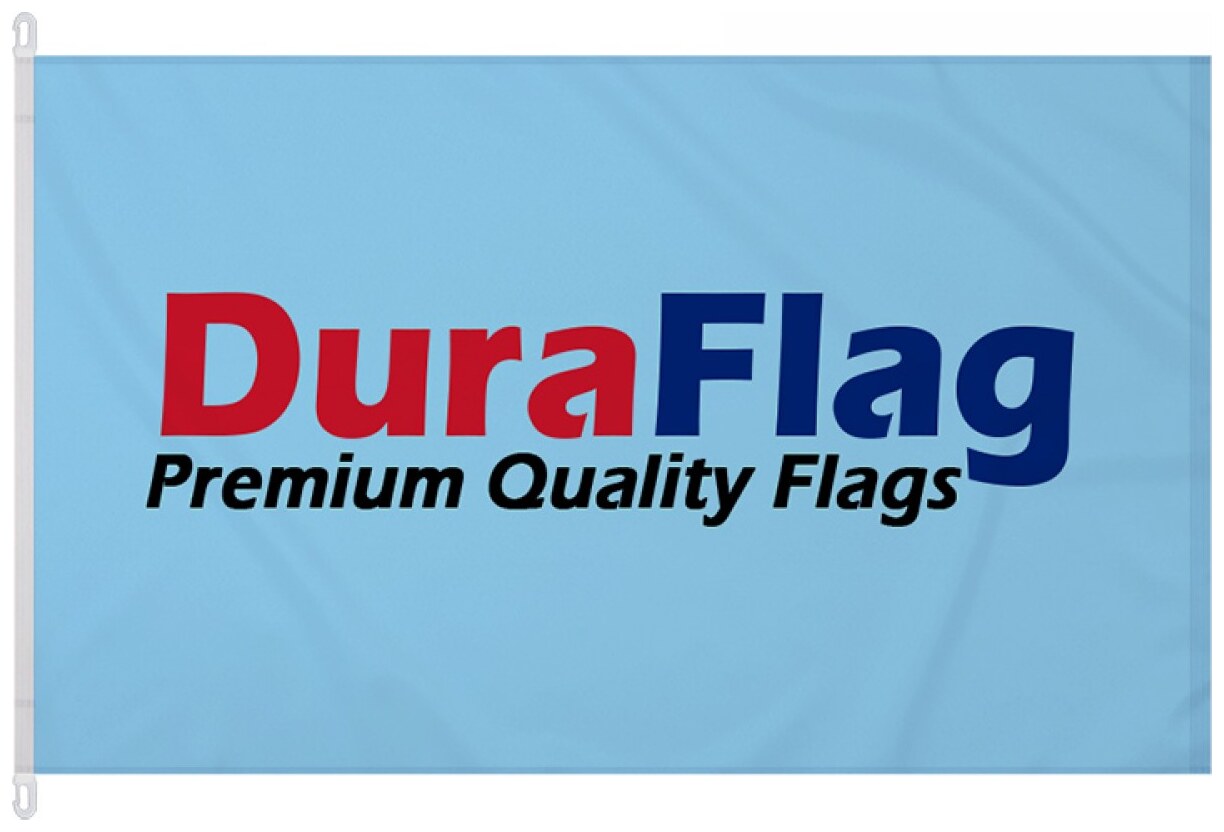
| DuraFlag | Digitally printed onto 115gsm knitted polyester; breathable, flies in a gentle breeze, washable | Year-round outdoor use, up to giant stadium flags | £37.99 | £61.99 |
| Heavy 210gsm | 210gsm fabric, B1 fire-retardant certified | Indoor venues, exhibitions, stadiums, schools and public buildings | £45.99 | £89.99 |
For an 8x5 flag, the lightweight fabric is £80.99, DuraFlag is £100.99 and the heavy flag is £157.99. The B1 certification on the heavy flag is often required by indoor venues, so check with the venue first if you are exhibiting or hanging a flag in a public building.
Any size, priced by area
Every custom flag can be made to any size. Pricing is based on area: a fixed making charge plus a rate per square metre. This means bigger flags are better value per square metre, which is worth bearing in mind if you are deciding between two sizes.
Free fittings
Fittings are included free. Choose from rope and toggle, metal eyelets, D-rings, clips, a sewn pole sleeve or plain sewn edges. The right choice depends on your pole or display system; our guide to flag fittings explained shows which fitting suits which pole.
Quantity discounts
Discounts apply automatically from 5 flags, with bigger savings at 10, 25, 50 and 100. If you need flags for several sites or a run of events, ordering together is usually better value than ordering one at a time.
Single-sided or double-sided
A single-sided flag is printed on one side, and the design shows through as a mirror image on the back. Logos and pictures still look good from behind, but any text reads backwards. A double-sided flag reads correctly from both sides. Choose double-sided when wording matters and people will see the flag from both directions, such as by a road or in the middle of a venue.
Artwork guidelines
Good artwork is the biggest single factor in how your flag looks. These guidelines will help you avoid delays at the proof stage.
| Area | Guideline |
|---|---|
| File format | Vector files (PDF, AI, EPS or SVG) are preferred. High-resolution PNG or JPG files are accepted if they are large enough. |
| Resolution | 150–300 dpi at the full printed size of the flag. |
| Colour | Supply artwork in CMYK. Give Pantone references for brand colours so we can match them as closely as possible. |
| Bleed and safe area | Add 3–5 mm bleed. Keep text and logos well inside the edge and clear of the hem or sleeve. |
| Fonts | Convert fonts to outlines so the text prints exactly as designed. |
| Text size | Use big, readable text. Small lettering is lost once the flag is moving. |
| Special colours | Metallics, gold, silver and fluorescent colours cannot be printed. Use a solid colour instead, such as a yellow or ochre in place of gold. |
| Shrinkage | Allow for slight fabric shrinkage, so avoid designs that rely on exact measurements right up to the edge. |
Why low-resolution images cause problems
An image that looks sharp on screen may be far too small for a flag. A logo copied from a website, for example, is usually only a few hundred pixels wide, and stretched to 5x3ft it becomes blurred and blocky. If you only have a small image, ask your designer for the original vector logo, which can be enlarged to any size without losing quality.
Design tips
- Keep it simple. A flag is usually seen from a distance and often while moving. One strong logo or message works better than lots of detail.
- Use two or three contrasting colours. Strong contrast, such as dark on light, is easier to read than similar shades side by side.
- Make it readable from a distance. Step back from your screen, or view the design at a small size, to see how it will look from across a car park or field.
- Think about the hoist side. The edge nearest the pole is partly hidden by the fitting, so keep important elements away from it.
- Remember the wind. On a flagpole, the fly end moves the most, so do not place key text right at that edge.
Rights to logos and images
You must own the rights to, or have permission to use, any logos, images and text in your artwork. This includes sports club badges, brand logos and photographs taken by someone else. If you are ordering on behalf of a club or company, make sure you have their approval to use their branding.
If your flags are for a business, our guide to flags for businesses compares logo, feather and forecourt flags. You can see every option in our custom flags category, and the wider custom items range includes table flags, hand flags and banners.
Frequently asked questions
How long do custom printed flags take?
Custom flags are typically ready in around 7 working days from artwork approval. Allow extra time for the proof stage if you have a fixed deadline.
What file format should I send?
Vector files such as PDF, AI, EPS or SVG are preferred. High-resolution PNG or JPG files are accepted if they are large enough to print at 150–300 dpi at full size.
Can you print gold or metallic colours?
No. Metallics, gold, silver and fluorescent colours cannot be printed. A solid colour that suggests gold, such as a warm yellow, is the usual alternative.
Which fabric should I choose for an exhibition?
Many indoor venues and exhibitions require fire-retardant materials. Our heavy 210gsm custom flag is B1 fire-retardant certified.
Do you charge for fittings?
No. Rope and toggle, metal eyelets, D-rings, clips, a sewn pole sleeve or plain sewn edges are included free.
Ready to start your design? Choose a fabric and size in our custom printed flags range.