European Union
 Confederate
 Rainbow
 Other Pride
 Red Ensign
 RAF Ensign
 Yorkshire
 Cornwall
 Union Jack
 England
 Scotland
 Wales
 USA
 Ireland
 France
 Germany
 Italy
 Australia

Lithuania has two independence days, and both are public holidays: 16 February, when the modern Lithuanian state was declared in 1918, and 11 March, when independence was restored in 1990. If you're searching for Lithuania Independence Day, 16 February is usually the bigger celebration, and the yellow, green and red flag is flown on both. This guide explains the difference, how Lithuanians in the UK mark the days, and how to fly the flag correctly.
16 February and 11 March: two dates, one story
| Date | Lithuanian name | What it marks |
|---|---|---|
| 16 February | Lietuvos valstyb?s atk?rimo diena | Restoration of the State, 1918 |
| 11 March | Lietuvos nepriklausomyb?s atk?rimo diena | Restoration of Independence, 1990 |
| 6 July | Valstyb?s diena (Statehood Day) | Coronation of King Mindaugas, 1253 |
Coming up: Tuesday 16 February 2027 and Thursday 11 March 2027.
16 February 1918. The twenty members of the Council of Lithuania signed the Act of Independence in Vilnius, declaring a democratic Lithuanian state. The word "restoration" in the holiday's name looks back further, to the medieval Grand Duchy of Lithuania.
11 March 1990. After five decades of Soviet rule, Lithuania's newly elected Supreme Council voted to re-establish independence, the first Soviet republic to do so. The act deliberately linked itself to 1918, which is why both days are celebrated side by side.
A third date, 6 July, celebrates the coronation of Mindaugas, Lithuania's only crowned king. On that evening Lithuanians around the world sing the national anthem, Tautiška giesm?, at the same moment, 9pm Lithuanian time.
Lithuania Independence Day traditions
In Vilnius, 16 February traditionally begins with the flags of the three Baltic states being raised together outside the Presidential Palace, followed by state awards, a youth march to the graves of the 1918 signatories, and sixteen bonfires along Gediminas Avenue in the evening. 11 March tends to feel younger and more festive, with concerts, marches and plenty of tricolour ribbons and face paint, particularly in Vilnius and Kaunas.
Lithuanians form one of the larger Baltic communities in the UK. Lithuanian Saturday schools, Catholic parishes (including the Lithuanian church in east London) and community associations commonly hold concerts, Masses and family days on or near the dates, and the Embassy of Lithuania in London typically hosts official events. Check local community pages for this year's arrangements.
Reading the Lithuanian tricolour
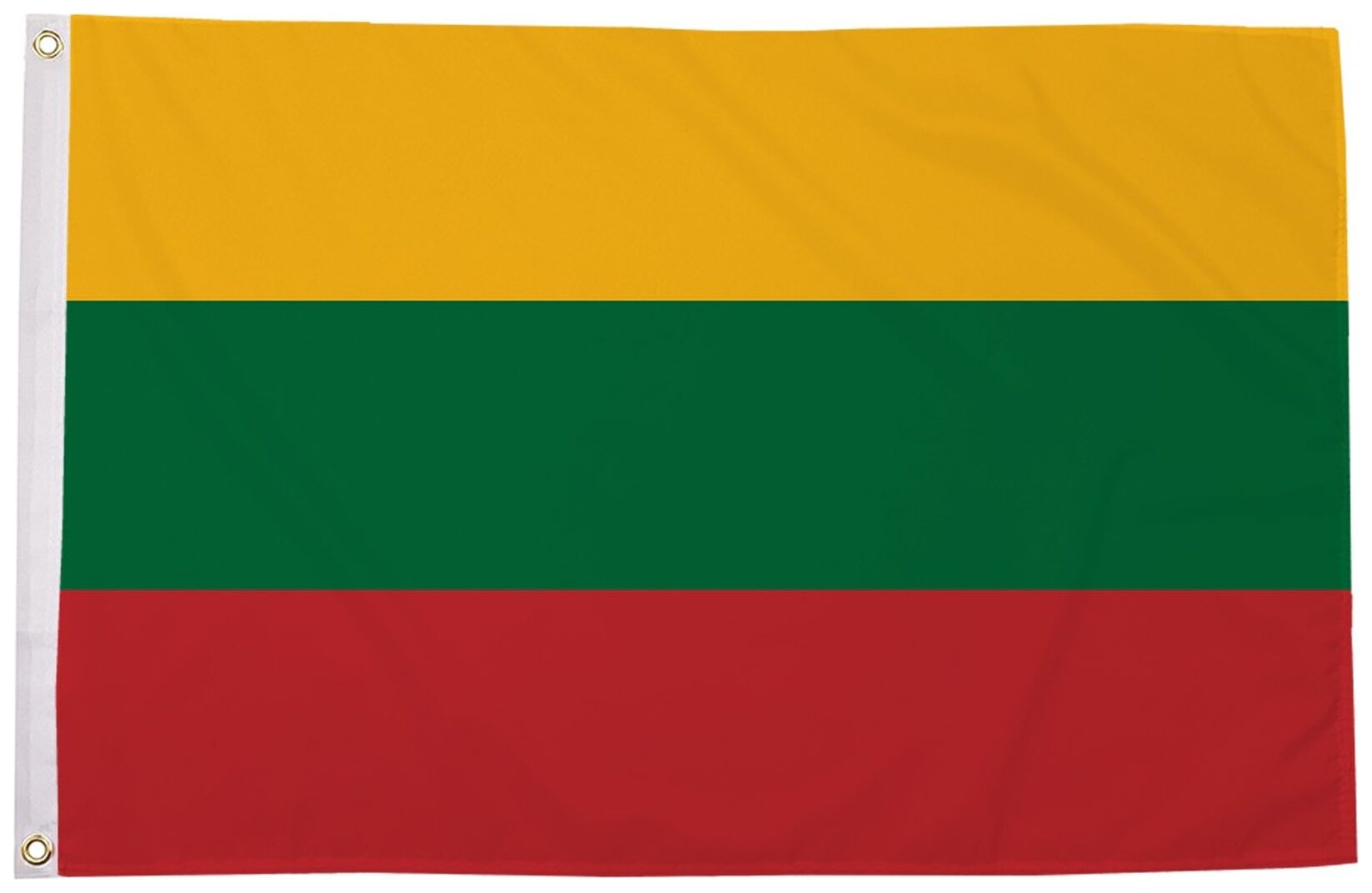
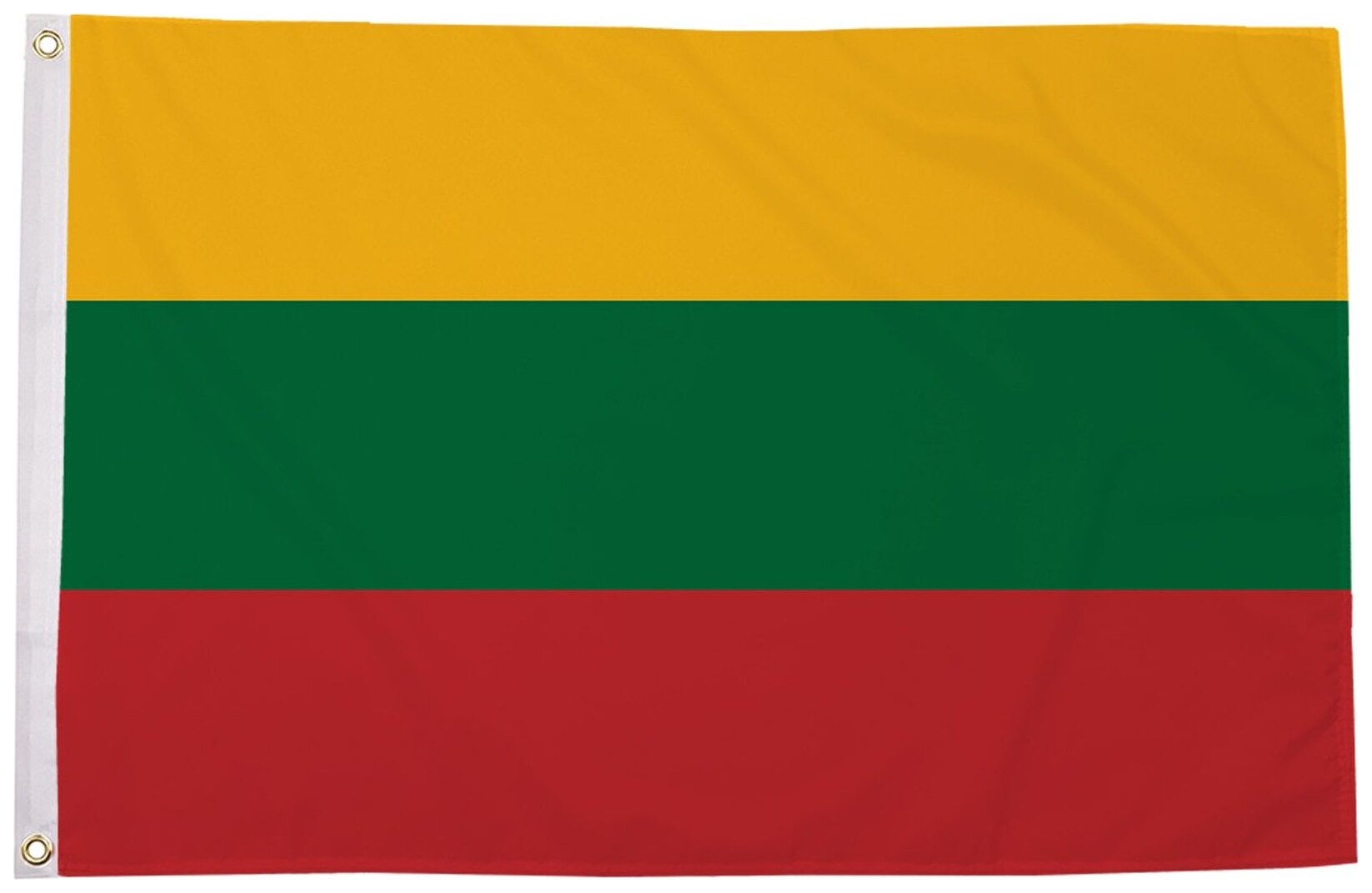
The flag has three equal horizontal stripes: yellow on top, green in the middle and red at the bottom. The usual interpretation is yellow for the sun and prosperity, green for the forests and hope, and red for courage and the blood shed for the country.
- Proportions: 3:5 under the flag law in force since 2004 (before that it was 1:2). Our 5ft x 3ft size matches the official shape exactly.
- Historical state flag: a red flag with the white mounted knight, Vytis, is flown at a small number of official sites as the historical flag of the state. The tricolour is the national flag for everyday use.
- Which way up: yellow always at the top. Hung vertically, yellow goes on the left as you look at it.
With the Union Flag, and with Latvia and Estonia
Fly each national flag from its own pole, at the same height and in the same size. In the UK the Union Flag normally takes the position of honour on the left as seen by the viewer. If you mark the Baltic link as Vilnius does, the three Baltic flags look best in a row of equal poles; our guide to flag precedence explains how to order them. Latvia's national day falls on 18 November, covered in our Latvian Independence Day guide.
Flags, bunting and table flags for the day
- Flagpole: the Lithuania flag in 5ft x 3ft for a home or club pole; for February winds, the Lithuania DuraFlag is the tougher choice.
- Indoors: Lithuania bunting for a community hall, school or shop window.
- Tables: Lithuania table flags for an embassy-style reception or a family meal.
- Marches and concerts: wooden hand flags, 9in x 6in for children or 18in x 12in for adults.
Frequently asked questions
When is Lithuania's Independence Day?
There are two: 16 February (1918 state restoration) and 11 March (1990 restoration of independence). Both are public holidays in Lithuania.
What do the colours of the Lithuanian flag mean?
Yellow is usually said to represent the sun and prosperity, green the forests and hope, and red courage and sacrifice.
What is the Lithuanian flag with the knight?
That is the historical state flag showing Vytis on a red field. It is used at certain official sites; the yellow-green-red tricolour is the national flag.
What size Lithuanian flag should I buy?
5ft x 3ft suits most home flagpoles and matches the flag's official 3:5 shape. See what size flag for your flagpole for other pole heights.
Browse every Lithuanian flag we stock, or the full range of world flags. For other dates across the continent, see our European national days guide.