European Union
 Confederate
 Rainbow
 Other Pride
 Red Ensign
 RAF Ensign
 Yorkshire
 Cornwall
 Union Jack
 England
 Scotland
 Wales
 USA
 Ireland
 France
 Germany
 Italy
 Australia

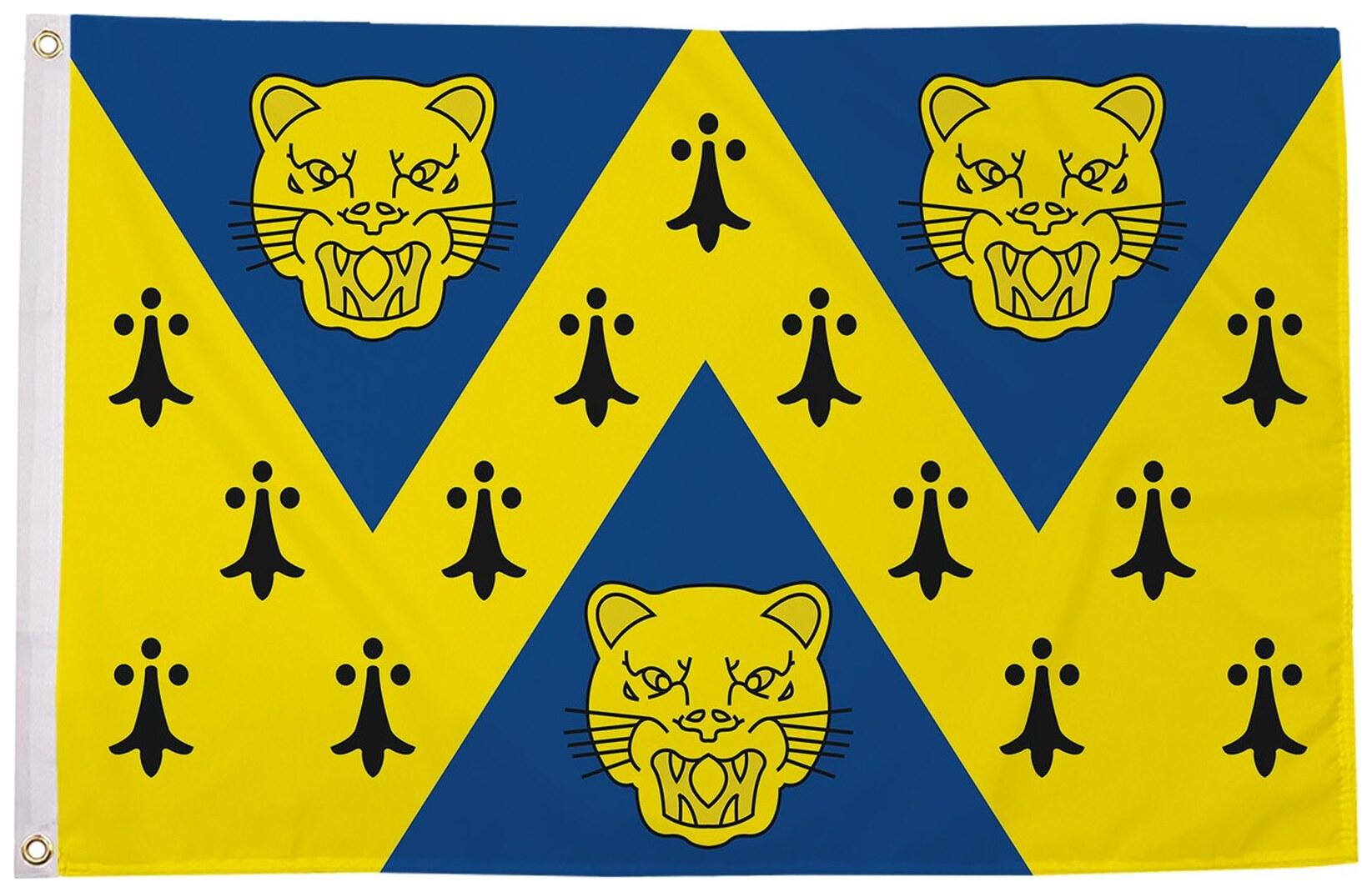
Shropshire Day is celebrated every year on 23 February, the feast day of St Milburga, the Anglo-Saxon abbess of Wenlock who is regarded as the county's patron saint. The usual way to mark it is to fly the Shropshire flag, the gold and blue design with three leopards' faces that locals call "loggerheads", from homes, churches, council buildings and businesses across the county.
It is the first county day of the year. Below is the story behind the date, what the flag means, and some practical ideas for flying it.
Who was St Milburga?
Milburga (Mildburh in Old English) was a Mercian royal, a daughter of King Merewalh of the Magonsæte, and became abbess of the monastery at Wenlock, in what is now Much Wenlock. She died on 23 February in the early eighth century; sources give either 715 or 727. The ruins of Wenlock Priory, rebuilt by Cluniac monks after the Norman Conquest, still stand on the site of her abbey.
Shropshire legends cling to her. One tells of barley that sprang up and ripened in a single day as she passed through a field, letting her escape pursuers. Another says that when wild geese were stripping the abbey's crops, she asked them to leave and they flew off and never returned. Her bones were reportedly rediscovered at Wenlock in the 1100s, which revived her cult in the Middle Ages.
The Shropshire flag and its loggerheads
The county flag is a banner of the arms granted to Shropshire County Council in the 1890s: a gold field with a blue "W" shape formed by three blue triangles, three gold leopards' faces on the blue, and black ermine spots on the gold.
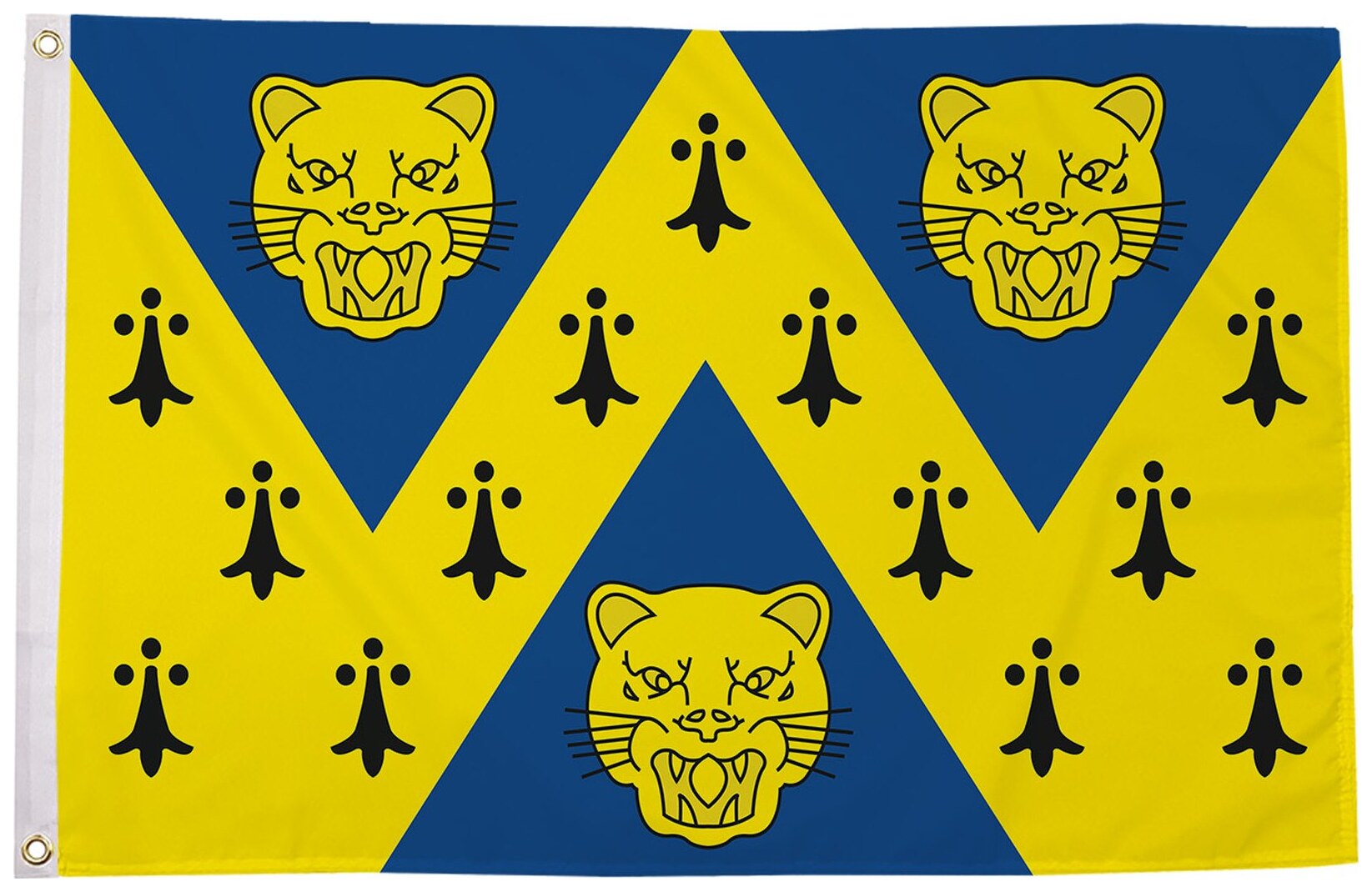
The leopards' faces go back much further than the county council. Shrewsbury, the county town, used three lions' or leopards' heads on its arms and seal from at least the fifteenth century, and the nickname "loggerheads" has stuck to them for centuries. The blue and gold are often linked to Roger de Montgomery, the Norman Earl of Shrewsbury who built Shrewsbury Castle.
The design was recorded on the Flag Institute's UK Flag Registry in 2012 as the county flag. That means it is treated as a community flag that anyone in Shropshire can fly, not just the council.
Old and new versions
Before registration, a version on a white background with simpler leopards' faces was widely sold, and you will still see it on older flagpoles. We stock both, so it helps to know which is which:
| Version | How to recognise it | Notes |
|---|---|---|
| Shropshire flag (registered) | Gold field, blue triangles, detailed loggerheads, black ermine spots | The design on the UK Flag Registry; the one councils fly |
| Shropshire "old" flag | White field, blue triangles, simplified faces | An older commercial design some people still prefer |
How Shropshire Day is marked
Shropshire Day has the backing of the county's Lord-Lieutenant and the Association of British Counties, and the flavour of the day is a mix of civic and church events. Recent years have brought services and short pilgrimages along the Ironbridge Gorge and around Much Wenlock, events at Oswestry Guildhall, and the county flag flying in New Palace Yard at Westminster. Exact events change from year to year, so check your parish, town council or the Lieutenancy for what is planned near you.
There is also a county toast, borrowed from the old saying about the hill that dominates the skyline: "All friends round the Wrekin". It makes a good line for a pub chalkboard or a school assembly.
Getting the flag out for 23 February
Late February can be wet and blustery in the Marches, which affects what you buy:
- House poles and brackets: a 5ft x 3ft flag suits most house poles and wall brackets. If it is going to stay up through spring, a Shropshire DuraFlag copes much better with wind than lightweight printed polyester.
- Churches, guildhalls and schools: larger poles usually take 8ft x 5ft. Our guide to matching flag size to flagpole height explains the rule of thumb.
- Indoors: February events tend to happen inside, so Shropshire bunting across a hall or bar, and table flags for a civic lunch or Shropshire produce tasting, are often more useful than a pole flag.
- Children: 9in x 6in hand flags on 30cm wooden sticks are a good size for primary pupils learning about Milburga and the geese.
Shropshire Day is followed by St Piran's Day in Cornwall and County Durham Day in March; the full list is in our county days calendar, and our guide to UK county flags explains how the registry works.
Frequently asked questions
When is Shropshire Day?
23 February every year, the feast day of St Milburga. It is not a bank holiday.
What are the faces on the Shropshire flag?
They are leopards' faces, known locally as loggerheads. They come from the old arms of Shrewsbury and have represented the county for centuries.
Why is the Shropshire flag sometimes white?
An older commercial version used a white background. The registered county flag has a gold background with black ermine spots.
Can anyone fly the Shropshire flag?
Yes. As a registered county flag it is free for anyone to fly.
Browse our full range of Shropshire flags, including the printed Shropshire county flag, or see every design in our British county flags collection and county bunting range.