European Union
 Confederate
 Rainbow
 Other Pride
 Red Ensign
 RAF Ensign
 Yorkshire
 Cornwall
 Union Jack
 England
 Scotland
 Wales
 USA
 Ireland
 France
 Germany
 Italy
 Australia



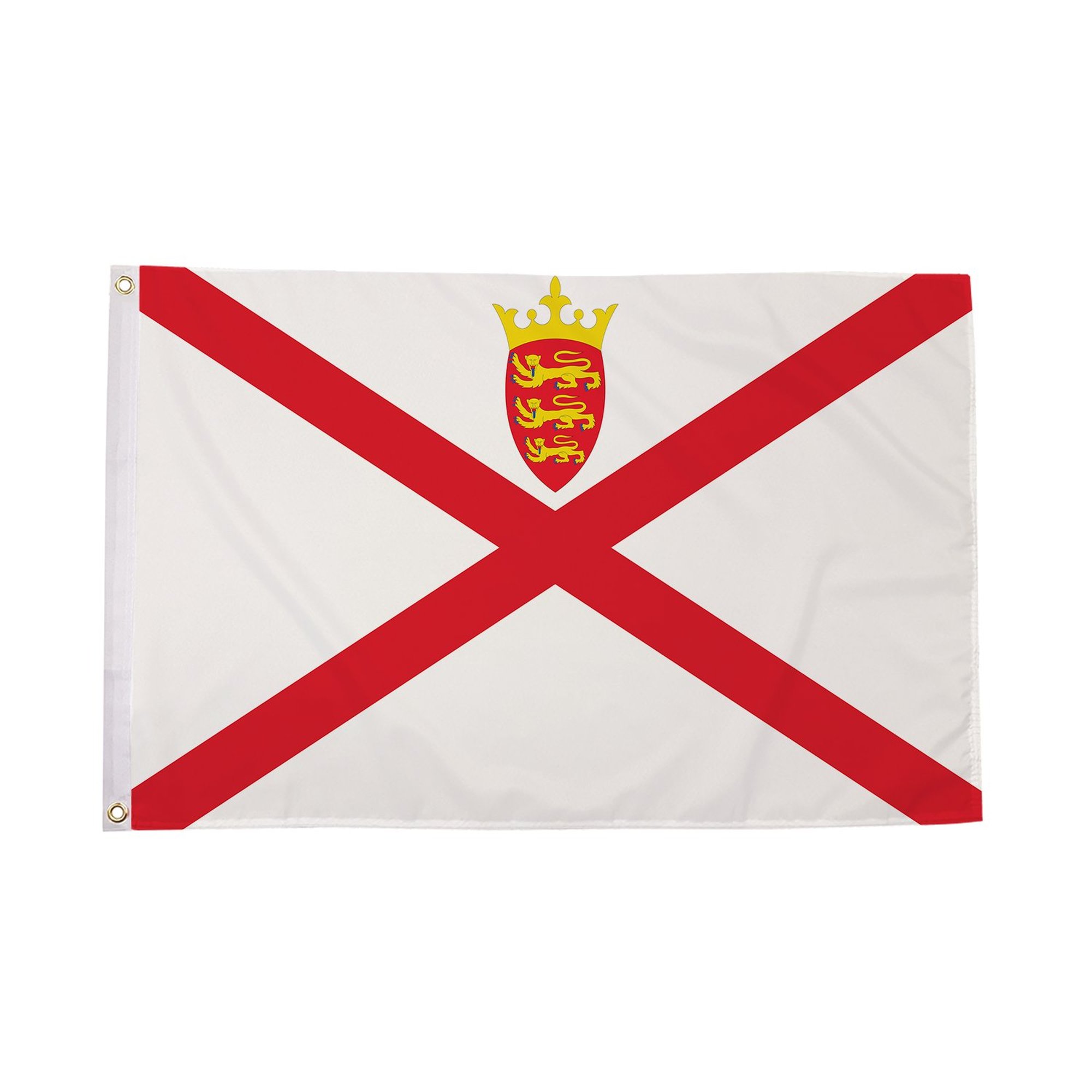
The flag of Jersey is a red saltire on white with the island's badge of three gold lions, or "leopards", beneath a gold crown. The badge and crown were added in 1981, after a long debate over whether the island needed a new flag at all.
Quick answer: Jersey's flag is a red diagonal cross (saltire) on white, with the badge of Jersey, three gold lions on red, under a Plantagenet crown in the top arm. The plain saltire has been in use since the 1820s; the current flag was approved by the States of Jersey on 12 June 1979, proclaimed by the Queen on 10 December 1980 and first officially hoisted on 7 April 1981.
The design
The field is white with a red saltire. In the upper arm sits the shield of the arms of Jersey, blazoned "gules three lions passant guardant in pale or": three gold lions, one above another, on red. Above the shield is a gold crown described as being of "ancient type" and commonly called the Plantagenet crown. [3] The Government of Jersey says the crown is a reminder that the crest has been used by Jersey since the time of Edward I. [1]
The plain red saltire
The Government of Jersey dates the red saltire on white to the 1820s. [1] Where it came from is disputed. In 1906 the Bailiff of Jersey wrote that the "red St Andrew's cross on white ground" had been the distinguishing flag of Jersey vessels during the centuries when the Channel Islands enjoyed the privilege of neutrality in wars between England and France. [3]
A rival theory, put forward by N. V. L. Rybot, holds that the flag began as a mistake: Dutch flag books captioned the red saltire, then regarded as an Irish flag, as "Ierse" (Irish), and the English publisher Carington Bowles is said to have read this as Jersey in his flag chart of 1783. Other researchers reject this, pointing out that no evidence has been produced that Jersey adopted the flag after the Dutch mix-up. [3]
By 1971 the flag historian Barraclough could write that the flag, though it had never received formal recognition from the British government, had been established as the island's flag "for well over a century" and was flown on public buildings and business premises. [3]
Occupation and Liberation
During the German occupation of the Channel Islands in the Second World War, the red saltire is reported to have been worn as an ensign by ships carrying passengers and cargo between the islands. [3] On 8 May 1945, after Winston Churchill's broadcast announcing that the Channel Islands too would be freed, the Bailiff, Alexander Coutanche, hoisted the Union Jack and the Jersey flag over the Courthouse. [4]
Adding the badge
The move to a new flag began in 1977, during the Queen's Silver Jubilee, when the island decided to adopt a more distinctive flag that would enhance Jersey's identity and avoid confusion with other uses of the plain saltire. [2] The clinching argument was that the traditional saltire had never been officially proclaimed. [3]
The question "raised passions". Many saw no need to change the flag at all, while a strong body of opinion would have preferred a flag of the island's three leopards, or possibly the two leopards of Normandy. A banner of the three leopards is the flag that hangs over the Bailiff's chair in the States Chamber. The design finally chosen, the saltire with the badge and crown added, can be seen as a compromise between these views. [3]
The States of Jersey approved the design on 12 June 1979 with only two votes against. The Queen issued the proclamation on 10 December 1980, and the flag was first officially hoisted on 7 April 1981 [2], the bicentenary year of the Battle of Jersey. [3]
Flag-flying protocol today
The Jersey flag has been designated by the Sovereign as the island's flag, so when it is flown with the Union Flag it should normally take precedence. The Bailiff requests flags to be flown, on behalf of the King, on buildings owned by the Crown or the Government of Jersey, on parish halls and on other public buildings on a list of flag days, which includes 9 May, the anniversary of the Liberation. On some occasions, such as Liberation Day and Remembrance Sunday, both flags are flown. The Bailiff also encourages islanders to fly the Jersey flag or the Union Flag on these days. [1]
Jersey's ensigns
At sea Jersey has two defaced ensigns. An Admiralty warrant of 2 March 1907 allowed the States of Jersey steam tug Duke of Normandy to wear the Blue Ensign with the badge of Jersey in the fly; later warrants of 1967 and 1997 covered its successors. [3] A Jersey Red Ensign, the Red Ensign with the badge and crown in the fly, was approved by the Queen and then unanimously by the States Assembly on 23 June 2010 for ships registered in Jersey; its use is optional. [3] [5]
Fly the Jersey flag
Midland Flags sells the Jersey flag in a range of sizes.
Sources
- Government of Jersey, "Flag flying days in Jersey: dates, occasions and protocol", Bailiff's Chambers.
- Bailiwick Express, "FOCUS: Why Jersey has the Silver Jubilee to thank for its flag", 30 May 2022.
- Flags of the World, "Bailiwick of Jersey", last modified 9 November 2024 (including contributions quoting Barraclough, Flags of the World (1971), and the 1907 Admiralty warrant).
- Jersey Heritage, "A brief history of the German Occupation of Jersey, 1 July 1940 – 9 May 1945".
- BBC News, "Jersey boats may fly own ensign", 9 April 2010.