European Union
 Confederate
 Rainbow
 Other Pride
 Red Ensign
 RAF Ensign
 Yorkshire
 Cornwall
 Union Jack
 England
 Scotland
 Wales
 USA
 Ireland
 France
 Germany
 Italy
 Australia

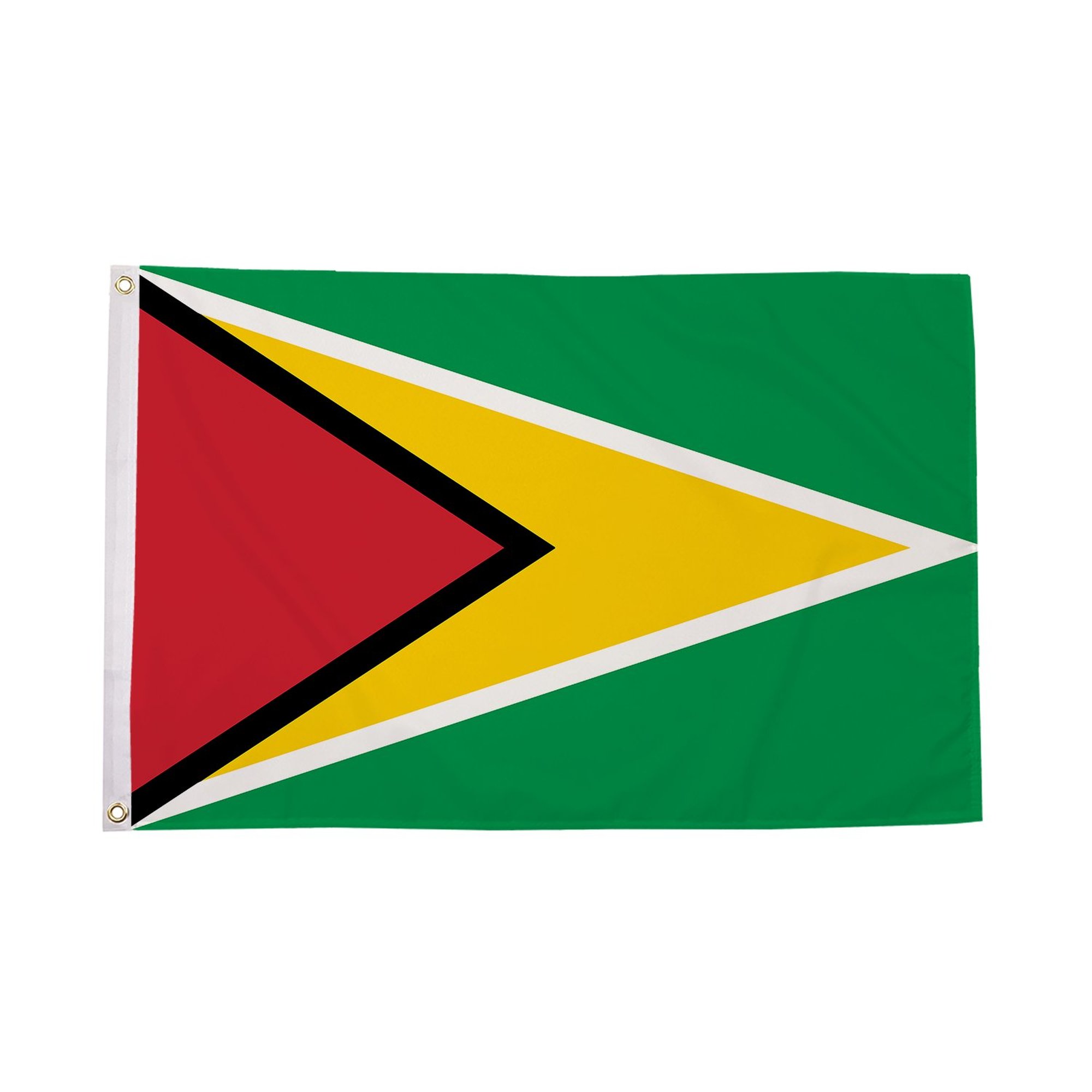
The flag of Guyana, known as the Golden Arrowhead, was first officially raised when the country became independent from the United Kingdom on 26 May 1966. Unusually for a national flag, its basic design came from a young American student of flags, Whitney Smith.
Quick answer: the flag of Guyana is green, with a gold arrowhead edged in white and a red triangle edged in black, both based at the hoist. It was designed by the American vexillologist Whitney Smith, modified before adoption, and first raised at independence on 26 May 1966. Its proportions are 3:5 on land and 1:2 at sea.
Whitney Smith's design
In 1960, while he was a 20-year-old political science undergraduate at Harvard University, Whitney Smith wrote to Dr Cheddi Jagan of British Guiana. Jagan invited him to submit his ideas, and Smith's design was later adopted with some modifications. [1] [2] Smith's own account, quoted by the Portland Flag Association, is that he sent a flag design to Jagan in 1960 and that it was "slightly modified" before Parliament adopted it. [3]
In anticipation of independence, which was then expected in 1962, an international flag competition was held, and the design and colours of the Golden Arrowhead were chosen from its entries; the winning five-colour design was Smith's. [3] [4] The flag was first officially raised when Guyana became independent on 26 May 1966. [3] Smith went on to write 27 books on flags and heraldry, and died on 17 November 2016. [5]
How the design changed
Smith's original proposal differed from the flag in use today. Reference works by Dorling Kindersley and William Crampton state that the original design had a red field, and that it was altered by the College of Arms in England in 1966, which also added the black and white edgings (fimbriations). [6] The Constitution of Guyana records that the flag's heraldic description was "presented by the Garter King of Arms from the Royal College of Arms, England". [7]
Not all accounts agree on who added the edgings. The Guyanese flag researcher Hemendra Bhola has reported a filmed interview with a member of the local design committee, who said that the committee itself reversed Smith's red and green, then added white to represent the country's waters and black to balance it, before sending the design to the College of Arms. [6]
The official description
Article 4 of the Constitution of the Co-operative Republic of Guyana, as amended by Act No. 6 of 2001, declares that the national flag is the flag known as the Golden Arrowhead, as set out in the Second Schedule. [7] The schedule gives the heraldic description, which begins "Vert upon a pile throughout issuant from the dexter or, fimbriated argent" and continues with a pile gules fimbriated sable upon the same base. In plain terms, a green field with a gold arrowhead edged in white, and on it a red triangle edged in black, both issuing from the hoist. [7]
The schedule also states that the flag is designed in the proportion of 3 by 5 on land and 1 by 2 at sea. [7]
What the colours mean
The Second Schedule interprets each colour: [7]
- Green: the agricultural and forested nature of Guyana.
- White: the country's waters and rivers potential.
- Gold: Guyana's mineral wealth and its forward thrust.
- Black: the endurance that will sustain the golden arrow's forward thrust into the future.
- Red: the zeal and dynamic nature of the nation-building that lies before the young and independent country.
No official shades have ever been set. Bhola notes that only the five colours are fixed, and that the arrowhead is always described as gold, never yellow. [6] For reference, the flag manuals for the London 2012 Olympic Games give Pantone 032 red, 109 yellow and 355 green. [6]
Ensigns
At sea Guyana uses the national flag in the longer proportions of 1:2 as its civil and naval ensign. [7] [8] Guyana also has a civil air ensign, apparently based on the British one: light blue, with a dark blue cross edged in white and the national flag in the canton, as described by Crampton in The Complete Guide to Flags (1990). [9]
Presidential standards
When Guyana became a republic in 1970, the presidential standard was set not by legislation but by a Proclamation of 23 February 1970 (Republic Day), relating to the Presidential Standard, Presidential Arms and Great Seal. The first standard was a square banner of the national arms. [10]
Later presidents have changed the standard by issuing proclamations amending the 1970 Proclamation. For example, on 6 October 1980, the day he became the first Executive President, Forbes Burnham issued Proclamation No. 3 of 1980, replacing the banner of arms with a new purple and white standard. [10]
Fly the flag of Guyana
Midland Flags sells the Guyana flag in a range of sizes.
Sources
- Stabroek News, "Designer of Golden Arrow Head passes away", 25 November 2016.
- Kaieteur News, "Golden Arrowhead designer dies", 25 November 2016.
- Portland Flag Association, "Whitney Smith's Flag of Guyana", 27 February 2016.
- Guyana Times, "Reflections on the day Guyana became a free Nation", 26 May 2019.
- The Flag Institute, "In memoriam: Whitney Smith", 22 November 2016.
- Flags of the World, "Guyana", last modified 15 November 2025.
- Laws of Guyana, Constitution of the Co-operative Republic of Guyana, Cap. 1:01, Article 4 and Second Schedule (L.R.O. 1/2012), Parliament of Guyana.
- Flags of the World, "Guyana - Flag for Use at Sea", last modified 13 July 2024.
- Flags of the World, "Guyana - Civil Air Ensign", last modified 9 November 2024.
- Flags of the World, "Guyana - Presidential Flag", last modified 13 July 2024.