European Union
 Confederate
 Rainbow
 Other Pride
 Red Ensign
 RAF Ensign
 Yorkshire
 Cornwall
 Union Jack
 England
 Scotland
 Wales
 USA
 Ireland
 France
 Germany
 Italy
 Australia


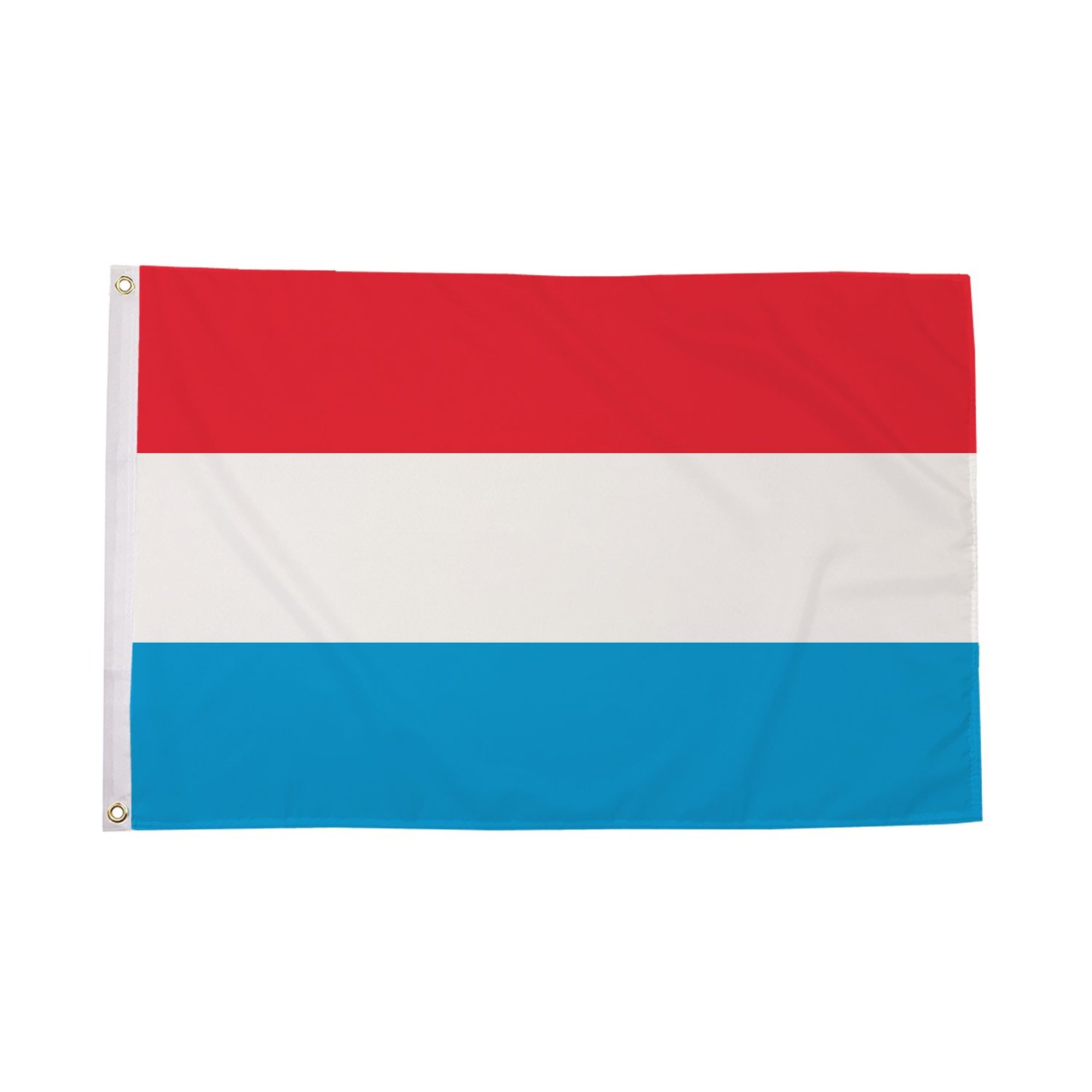
The flag of Luxembourg is a red, white and light blue horizontal tricolour, often mistaken for the flag of the Netherlands. Its colours come from the Luxembourg coat of arms, its layout was fixed in 1845, and it has been protected by law since 1972. A long-running debate over whether to replace it with the Red Lion flag, the "Roude Léiw", ended with the two flags existing side by side.
Quick answer: Luxembourg's flag has three equal horizontal stripes of red, white and sky blue, in the proportions 5:3 or 2:1. The red is Pantone 032C and the blue Pantone 299C. The tricolour was set out in 1845, defined in law on 23 June 1972, and given its official colours in 1993. Its similarity to the Dutch flag is a coincidence.
The design in law
The flag is defined by the law on national emblems of 23 June 1972, published in the Mémorial (A no. 51) on 16 August 1972. Article 3 states that the national flag consists of three equal bands of red, white and blue arranged horizontally, in the proportions of 5 to 3 or 2 to 1. [2] The same law defined the arms of the state and, in Article 4, the flag for inland shipping and aviation (see below). [2]
A Grand-Ducal regulation of 27 July 1993 fixed the colours: the red corresponds to Pantone 032C and the blue to Pantone 299C. [4] A law of the same date amended the 1972 law so that the precise colours are set by Grand-Ducal decree, and added that the pictures in the annex are for illustration only, "le texte seul faisant foi" (only the text is authoritative). [3]
Not the Dutch flag
The resemblance to the flag of the Netherlands is coincidental: the two flags do not share a common origin, and Luxembourg's colours come from its coat of arms. [1] To tell them apart, the government's own guide to the national symbols explains that "a pragmatic solution" was adopted: the Dutch blue is an ultramarine, while the blue of the Grand Duchy is a sky blue (Pantone 299C). [5]
History
1830: the colours appear
According to the vexillologist William Crampton, flags in the colours of the arms, red, white and blue, were first used in 1830, during the Belgian revolt against Dutch rule in which Luxembourg took part. [1] At first the three colours were displayed in no fixed arrangement. [1]
1845: the tricolour is fixed
The horizontal tricolour was defined on 12 June 1845. In a circular letter to district chiefs and mayors, the Governor, Ignace de la Fontaine, who represented the King of the Netherlands as Grand Duke, informed them that the red-white-blue arrangement should henceforth be considered the national flag. [1]
1972 and 1993: the law
Although the flag had been in use for well over a century, it had no legal protection until the law of 23 June 1972. [1] [2] The government's guide notes that the arms and flag have been defined and protected by law since 1972, and that the 1993 law confirmed the legal status of the national symbols and added the national anthem. [5]
The Red Lion: ensign of ships and aircraft
Article 4 of the 1972 law defines the flag for inland shipping and aviation in proportions of 7 to 5: ten stripes of white and blue with a red lion rampant, turned towards the pole, crowned, armed and langued in gold, with a forked and crossed tail. [2] The 1993 regulation sets its colours as Pantone 032C red, 299C blue and 116C yellow. [4] The design is a banner of the lesser arms of the state, popularly called the Roude Léiw (Red Lion). [1]
For political reasons NATO aircraft are registered in the Grand Duchy, and since the mid-1980s these aircraft have also carried a roundel based on the national arms: a red lion on a blue and white striped disc. [6]
The flag debate
On 5 October 2006 the MP Michel Wolter (CSV) tabled bill no. 5617 to replace the tricolour with the Red Lion as the national flag. [7] [8] On 6 July 2007 the Government Council confirmed its view that the tricolour should keep its status as the national flag, but that on Luxembourg's own territory the Red Lion could be used on equal terms with it. Prime Minister Jean-Claude Juncker summed up: "Déi zwee Fändelen hu kee Sträit mateneen. Si gehéieren zesummen" ("The two flags have no quarrel with each other. They belong together"). [7]
The debate returned in July 2015, when a petition (no. 523) by Marc Dax asking for a referendum on altering the flag to include the Red Lion was opened for signatures. The Red Lion is also used by supporters at sporting events such as the Tour de France. [8]
National Day
In Luxembourg, 23 June is the official celebration of the sovereign's birthday, commonly called National Day. Under Grand Duchess Charlotte, who came to the throne in 1919, National Day was 23 January; the official date was moved to 23 June in 1961 by Grand-Ducal order. [9]
Fly the Luxembourg flag
Midland Flags sells the Luxembourg flag in a range of sizes.
Sources
- Flags of the World, "Luxembourg", last modified 12 April 2025.
- Loi du 23 juin 1972 sur les emblèmes nationaux, Mémorial A no. 51, 16 August 1972. Legilux, official text.
- Loi du 27 juillet 1993 modifiant et complétant la loi du 23 juin 1972 sur les emblèmes nationaux, Mémorial A no. 73, 16 September 1993. Legilux, official text.
- Règlement grand-ducal du 27 juillet 1993 précisant la composition chromatique des couleurs du drapeau national luxembourgeois et du pavillon de la batellerie et de l'aviation, Mémorial A no. 73, 16 September 1993. Legilux, official text.
- Service Information et Presse du gouvernement luxembourgeois, "À propos ... des symboles de l'État et de la Nation" (2003). Archived copy.
- Flags of the World, "Luxembourg: Air ensign and roundels", last modified 7 February 2025.
- Gouvernement du Luxembourg, "Jean-Claude Juncker sur la question du drapeau national", July 2007.
- Chronicle.lu, "Roude Léiw Flag Debate Reignited", 31 July 2015.
- Cour grand-ducale, "National Day".