European Union
 Confederate
 Rainbow
 Other Pride
 Red Ensign
 RAF Ensign
 Yorkshire
 Cornwall
 Union Jack
 England
 Scotland
 Wales
 USA
 Ireland
 France
 Germany
 Italy
 Australia



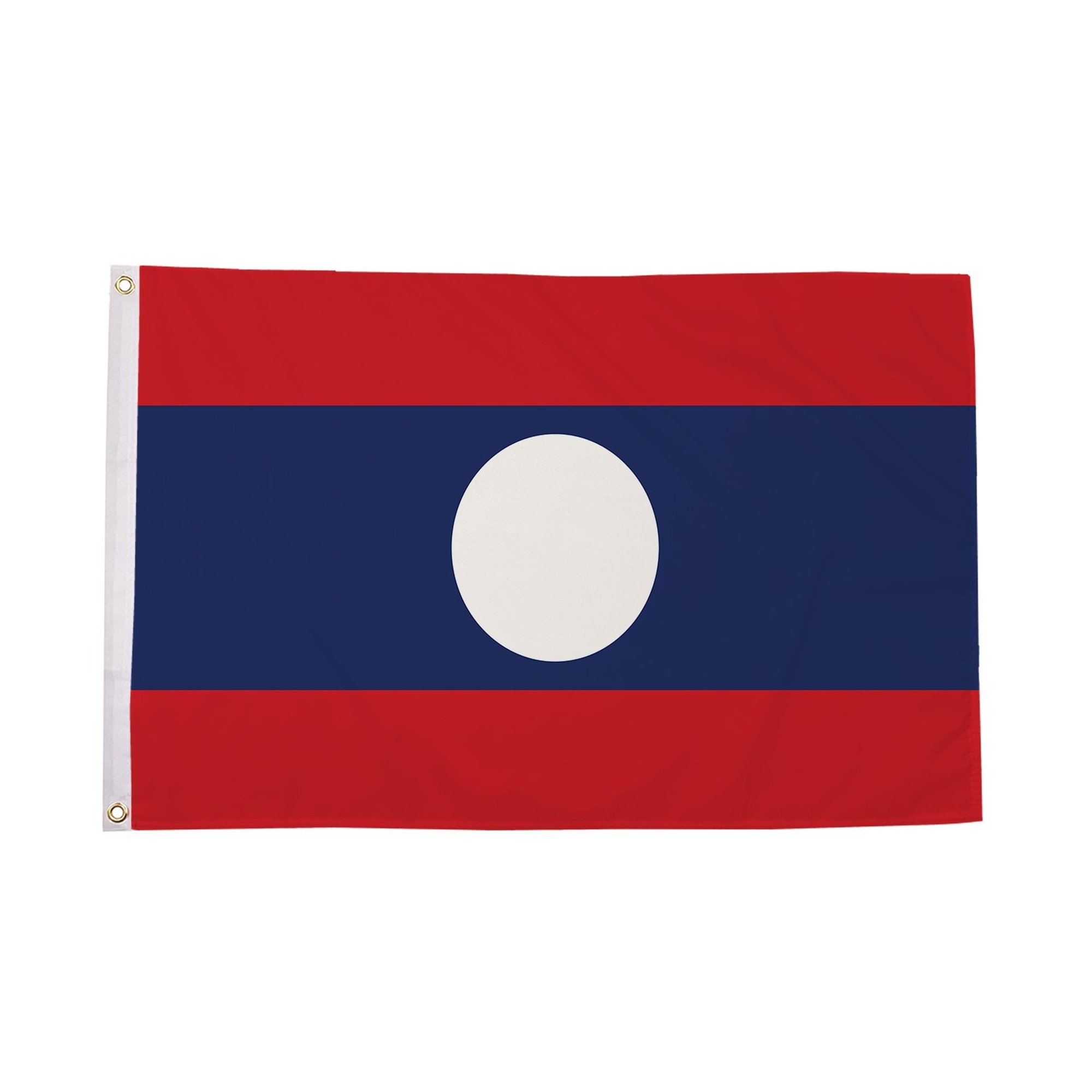
The flag of Laos is, as Flags of the World puts it, one of the few communist-style flags without a star. [3] Its design, a white disc on a blue band between two red stripes, is older than the Lao People's Democratic Republic itself: it was first raised by the short-lived Lao Issara government in 1945 and became the national flag again when the Pathet Lao took power in 1975.
Quick answer: the Lao flag has red stripes at the top and bottom and a dark blue band, twice as tall, in the middle, with a white disc (the "moon") in the centre. The flag is two-thirds as tall as it is wide. It was first used by the Lao Issara government in 1945 and was readopted as the national flag in 1975, replacing the royal flag with its white three-headed elephant.
The design in the constitution
The flag is defined in Article 112 of the Constitution of the Lao People's Democratic Republic: "The National Flag of the Lao People's Democratic Republic is dark blue with red edges and a white moon in the middle of the flag. The height of the flag is two-thirds of its width. The height of each red edge is one-half of the height of the dark blue area. The [diameter of the] white moon is four-fifths of [the height of] the dark blue area." [1]
In practice this means three horizontal stripes in the proportions 1:2:1, with the disc's diameter equal to two-fifths of the flag's height. A construction sheet published by Flags of the World shows the same figures. [3] The earlier 1991 constitution, quoted on the same page, described the flag in similar terms in its Article 77. [3]
Note that the constitution itself calls the white disc a "moon". [1]
Colours
The constitution does not give precise shades. The flags manual prepared for the London 2012 Olympic Games, whose designs were approved by each National Olympic Committee, specified Pantone 032 for the red and Pantone 293 for the blue. [3] These are not an official government specification, but they are what the Lao Olympic committee accepted as the national flag.
What the flag means
Accounts of the symbolism vary. According to a study of Thai support for the Lao independence movement by the historian Eiji Murashima, the flag's creators intended the navy-blue band to represent the Mekong River and the two red stripes to stand for its left and right banks: Laos and north-eastern Thailand. [2]
Later explanations, collected by Flags of the World, give other readings. The red is said to stand for the blood shed in the struggle for freedom and the blue for wealth or for the Mekong; the white disc is described as a full moon over the Mekong River, as a symbol of the reunification of the Lao lands divided by the river (Le Figaro, 1978), and as a symbol of the unity of the people under the leadership of the Lao People's Revolutionary Party. [3]
Origins: the Lao Issara flag of 1945
After the Japanese surrender in 1945, the Lao Issara ("Free Lao") movement set up its own government in Vientiane. On 12 October 1945 it proclaimed a 41-article Lao Issara Constitution. [2] Murashima records, on the testimony of Siphanom Phichitwarasan, that the flag used by the Lao Issara government, which is still the national flag of Laos today, was conceived by a group of Lao intellectuals that included Maha Sila Viravong and Amphon Suwannabon. [2]
The Lao Issara wanted a national flag with no royal symbol on it, distinct from the royal elephant flag. Their government lasted only months before the French regained control, but the movement carried on as a government-in-exile. [2] [3] The dissolution of the Lao Issara government-in-exile was announced on 24 October 1949. [2] The communist Pathet Lao, which presented itself as the Lao Issara's successor, kept the flag as its own. [3]
The royal flag it replaced
During French rule, which began in 1893, Laos used the flag of the kingdom of Luang Prabang with the French tricolour in the canton. [5] From 1952 until 1975 the Kingdom of Laos flew a red flag bearing a white three-headed elephant standing on a pedestal beneath a parasol. [4] The elephant is Airavata (Erawan), the mount of the Hindu god Indra. The three heads are often said to represent the three old Lao kingdoms, but Flags of the World notes, drawing on the historian Grant Evans's book The Politics of Ritual and Remembrance: Laos Since 1975, that the flag was originally that of the single kingdom of Luang Prabang, and that the three-kingdoms explanation came later. [3] [4]
1975 to today
When the Pathet Lao took power in 1975, its flag replaced the royal flag as the national flag. [3] The Lao People's Democratic Republic was proclaimed on 2 December 1975, which the constitution fixes as the national day. [1]
Fly the Laos flag
Midland Flags sells the Laos flag in a range of sizes.
Sources
- Constitution of the Lao People's Democratic Republic (2015), Articles 112 and 114, English translation. Constitute Project, "Laos 2015".
- Eiji Murashima, "Thailand and Indochina, 1945-1950", Journal of Asia-Pacific Studies (Waseda University) no. 25, December 2015 (flag: p. 144). Archived copy.
- Flags of the World, "Laos", last modified 20 June 2026.
- Flags of the World, "Laos, 1952-1975", last modified 10 August 2024.
- Flags of the World, "Laos during the French Protectorate", last modified 3 June 2023.