European Union
 Confederate
 Rainbow
 Other Pride
 Red Ensign
 RAF Ensign
 Yorkshire
 Cornwall
 Union Jack
 England
 Scotland
 Wales
 USA
 Ireland
 France
 Germany
 Italy
 Australia

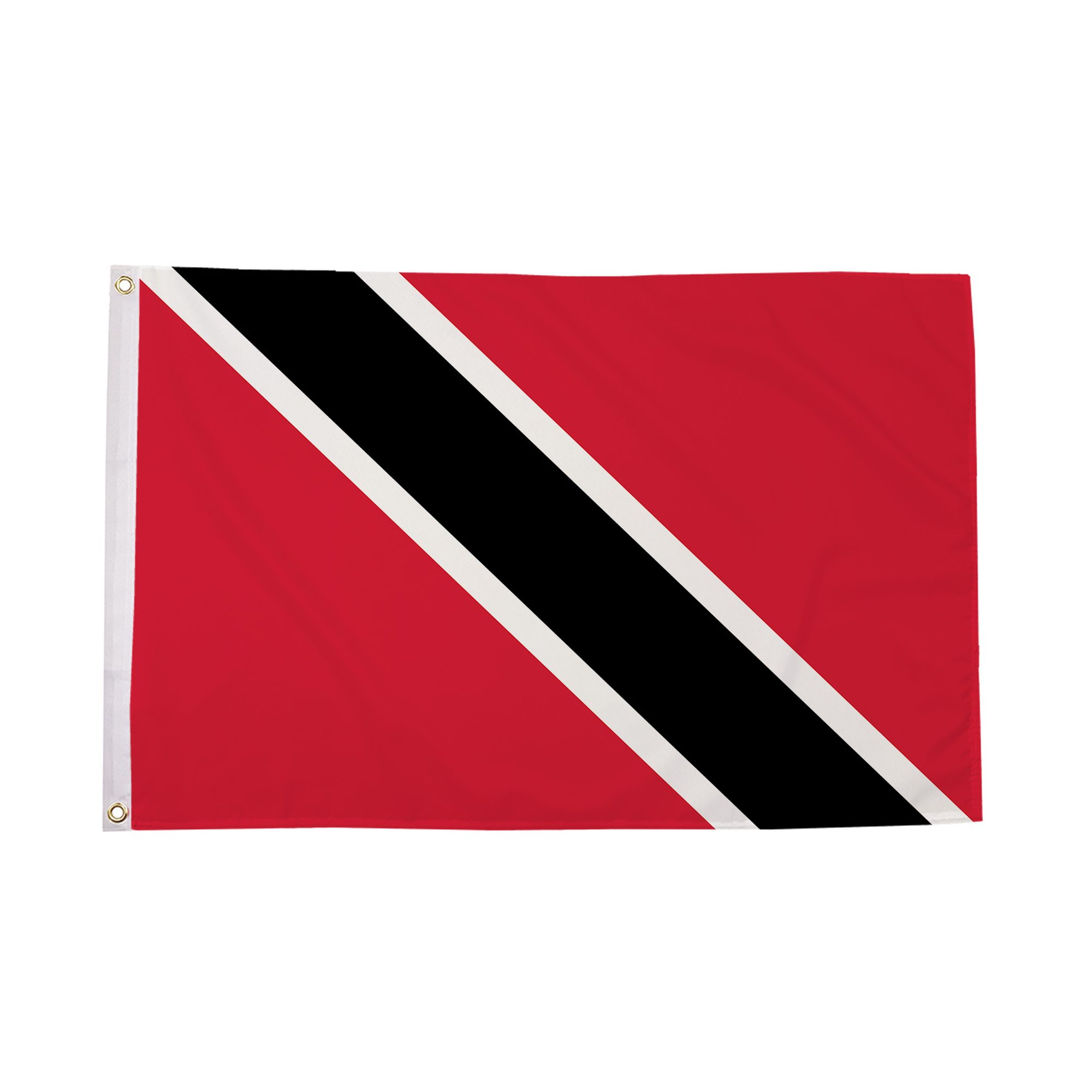
The flag of Trinidad and Tobago was adopted for the country's independence from the United Kingdom on 31 August 1962, the day its official specifications were issued. [4] Its red field crossed by a black diagonal edged in white is one of the few national flags built on a diagonal band, and its colours were given a meaning drawn from the elements of earth, water and fire.
Quick answer: the flag of Trinidad and Tobago is red with a black diagonal band, edged in white, running from the upper hoist to the lower fly. It was chosen in 1962 from designs created by the Independence Committee. Red stands for fire and the vitality of the people, white for the sea, and black for dedication and unity. The flag is 3:5 on land and 1:2 at sea.
Who designed it
The Government of Trinidad and Tobago says the national flag was selected from a series of designs created by the Independence Committee in 1962. [1] [2] The artist Carlisle Chang, who served on eight committees preparing for independence, is credited by the Ministry responsible for culture as the artist whose work is "immortalised in the Coat of Arms and national flag of Trinidad and Tobago". Chang received the Hummingbird Award in 1964 and died in 2001. [3]
What the colours mean
According to the Government, red, white and black were chosen to reflect the philosophy of a new nation, and they represent the elements of earth, water and fire. [1] The official descriptions are:
- Red, "the colour most expressive of our country": the vitality of the land and its people, the warmth and energy of the sun, and the courage and friendliness of the people. [1] [2]
- White: the sea by which the islands are bound, the cradle of the nation's heritage, the purity of its aspirations and the equality of all. [1] [2]
- Black: the dedication of the people joined together by one strong bond; the colour of strength, unity of purpose and the wealth of the land. [1] [2]
The official description and proportions
The specifications issued by the Ministry of Home Affairs on 31 August 1962, as reproduced in a later government booklet, describe the flag in heraldic terms: "On a red field, a Bend Dexter Sable bordered Silver", that is, a black diagonal bordered with white running from the upper corner by the staff. The black and white bands together are one-fifth of the length of the flag, and each white band is one-sixth of that combined width, so the black is four-sixths. The diagonal must always point to the peak of the staff. [4]
Put another way, each white edge is one-thirtieth of the flag's length and the black band two-fifteenths. The Office of the President confirms the proportions: 5:3 (that is, 3:5 height to length) on land, and 2:1 for the Coast Guard and ships at sea, with the stripes one-fifth of the flag's dimension. [2]
The colours in practice
No legal document has been found that sets exact shades for the flag. [4] Reference works give approximate values: the flag manuals for the Beijing 2008 Olympic Games give Pantone 032 red, those for London 2012 give Pantone 186 red and black, and the Album des Pavillons (2023) gives Pantone 186c, CMYK 10-100-74-2, RGB 210-16-52 for the red. [4]
Flag-flying days
The flag regulations list the days on which the national flag may be flown freely by all citizens: Independence Day (31 August), Republic Day (24 September), Remembrance Day (the second Sunday in November), and any other date that may be prescribed. [4]
Ensigns at sea
The civil and state ensign is the national flag in the longer proportions of 1:2. [5] The naval ensign, flown by the Trinidad and Tobago Coast Guard, is a white ensign: a white flag with a red cross throughout and the national flag in the canton. [5]
Before independence
Under British rule the colony flew a British Blue Ensign defaced with a colonial badge. A badge was introduced on the Blue Ensign and the governor's Union Flag for Trinidad in 1875. When Tobago was joined to Trinidad in 1889, Trinidad's badge became the badge of Trinidad and Tobago, and it was used until about 1958, when the same scene was placed within a shield with the motto on a scroll beneath. [6]
The flag historian David Prothero noted that there was no official Red Ensign with the badge; an example of such a red ensign from a private flag collection was shown at the International Congress of Vexillology in York in 2001, but its origin is unclear and it may have been unofficial. [6] Between 1966 and 1976 Queen Elizabeth II also had a personal flag for Trinidad and Tobago, based on the country's arms; it fell out of use when the country became a republic. [6]
Fly the Trinidad and Tobago flag
Midland Flags sells the Trinidad and Tobago flag in a range of sizes.
Sources
- Ministry of Foreign and CARICOM Affairs, Government of the Republic of Trinidad and Tobago, "National Flag".
- Office of the President of the Republic of Trinidad and Tobago, "National Symbols".
- Ministry of Community Development, Culture and the Arts, Government of the Republic of Trinidad and Tobago, "Carlisle Chang". Archived copy, 11 September 2016.
- Flags of the World, "Trinidad and Tobago", last modified 10 May 2025.
- Flags of the World, "Trinidad and Tobago - Ensigns", last modified 14 December 2024.
- Flags of the World, "Trinidad and Tobago - Colonial and Pre-republican Flags", last modified 25 August 2021.