European Union
 Confederate
 Rainbow
 Other Pride
 Red Ensign
 RAF Ensign
 Yorkshire
 Cornwall
 Union Jack
 England
 Scotland
 Wales
 USA
 Ireland
 France
 Germany
 Italy
 Australia

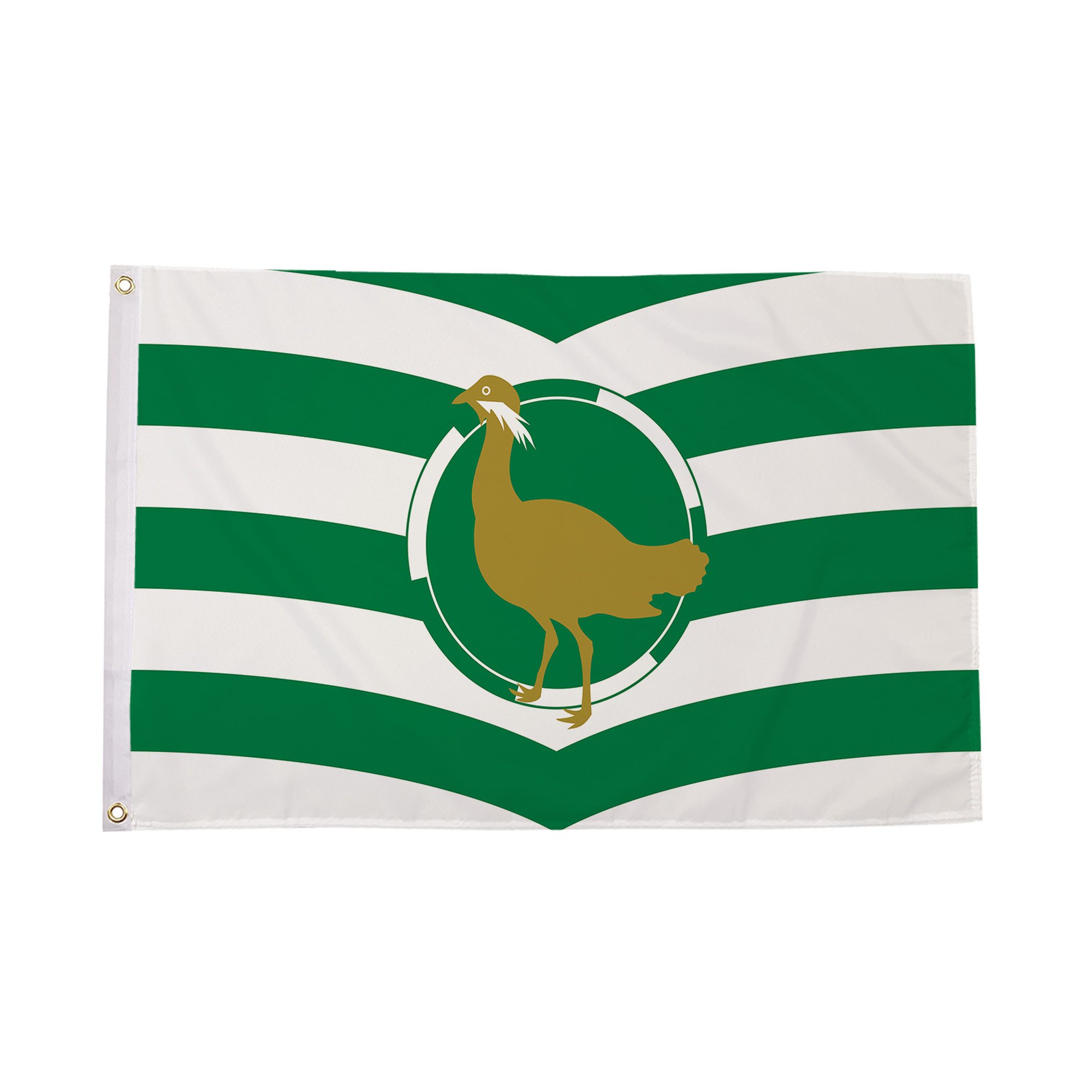
Wiltshire's county flag is one of the newest in England and one of the most debated. Its green and white stripes and gold great bustard were the work of a Trowbridge family, and it became the county flag only after a council vote, a rival design from a student campaigner, and a long argument about which symbol really stands for Wiltshire.
Quick answer: the Wiltshire flag, often called the Bustard Flag, shows a gold great bustard on a green disc, ringed by six green and white segments, on a field of curved green and white stripes. It was designed by Mike Prior's family business, approved by Wiltshire Council on 1 December 2009 and registered with the Flag Institute.
The design
The Flag Institute's UK Flag Registry records the flag as a county flag dated 1 December 2009, designer Mike Prior, adopted through the local council, in the proportions 3:5 and the colours white, Pantone Green 347 and Gold 873. [1] The centre is a gold great bustard (Otis tarda) on a solid green circle. The rim of the circle is made of six sections in alternate green and white, which recall the stone circles of Stonehenge and Avebury and also stand for Wiltshire's six neighbouring counties. Behind this is a field of green and white wavy stripes for the county's open grassland and the chalk beneath it. [1]
The design was drawn by Mike Prior's daughter, Helen Pocock, who worked with him in the family print business. She took the green and white stripes from the county council's arms as her starting point and followed the basic rules of flag design: keep it simple, use relevant symbols, no more than three colours, and no lettering. [2]
From back garden to County Hall
The flag was first raised on 24 September 2006 in the Priors' garden in Trowbridge, at a launch attended by the Marquess of Bath, the mayor of Trowbridge and the town crier. [2] It was flown at County Hall in Trowbridge from Tuesday 5 June 2007. [3]
The White Horse rival
A rival design was already in circulation. In March 2006 BBC News reported that Chris Fear, a 21-year-old student from Corsham, had begun a campaign for a county flag based on Wiltshire's white horse hill carvings. [4] His flag is a white horse on a dark green field; he argued that the white horse was "already a well-recognised, traditional symbol of Wiltshire". [5]
The horse itself was taken from a sketch of the Cherhill White Horse in William Plenderleath's book The White Horses of the West of England, published in 1885, shown in the green and white of a chalk figure cut into turf. Fear's design was never formally put to the county's officials or residents for approval; he hoped that people would simply adopt it, as had happened with the Pembrokeshire flag. [6]
Adoption in 2009
By late 2009 it emerged that the Bustard Flag, despite flying over County Hall, had never been formally registered with the Flag Institute, and the council was due to decide the question again on 1 December. [5] On that day the councillors of Wiltshire Council officially accepted the Bustard Flag, and it was registered with the Flag Institute with 1 December 2009 as its date. [1] [2]
The council that adopted it was the new Wiltshire Council, a unitary authority created in 2009. The ceremonial county of Wiltshire is made up of two unitary areas, Wiltshire and Swindon. [2] Swindon, then the borough of Thamesdown, had left the area of Wiltshire County Council on 1 April 1997 under the Wiltshire (Borough of Thamesdown) (Structural Change) Order 1995. [7] The Flag Institute registry nonetheless describes the Bustard Flag as proclaiming the identity of "this historic English county". [1]
Mike Prior kept promoting it afterwards. At the 2011 Glastonbury Festival he offered to refund half of a Trowbridge festival-goer's £200 ticket if he got the flag on television, and it was seen in front of the Pyramid Stage during sets by BB King, Elbow, Coldplay and U2. [8]
The county council's arms and banner
The stripes come from the arms granted on 5 April 1937, blazoned "Barry of eight Argent and Vert on a Canton of the first a Dragon rampant Gules": eight white and green bars, with a red dragon, the dragon of Wessex, on a white canton. The crest is a great bustard. [9] A banner of these arms was sold commercially for years, but it was never the county flag: only the council could use it. [6] Some commercial versions also show the dragon on a green background, which is wrong, because "of the first" in the blazon means the canton is white. [6] [9]
Criticism
Critics fell into three camps: those who felt the bustard was not a relevant symbol, those unhappy with how it was adopted and registered, and flag enthusiasts and heraldists who found the design complicated. The gold of the bird often looks beige and does not stand out at a distance, and the curved stripes give the flag an uneven look. [6] The same writer points out that the bustard had already been the crest of the county arms for seventy years and that its return to Salisbury Plain was a conservation success. [6]
Fly the Wiltshire flag
Midland Flags sells the Wiltshire flag in a range of sizes.
Sources
- The Flag Institute, "Wiltshire", UK Flag Registry.
- Flags of the World, "Wiltshire (England)", last modified 1 February 2022 (includes an extract from Wiltshire Life contributed by Helen Pocock, 17 May 2007).
- BBC Wiltshire, "The Wiltshire flag unfurls!", June 2007.
- BBC News, "Student campaigns for county flag", 28 March 2006.
- Sarah Jones, BBC Wiltshire, "Wiltshire County's flag wars", 30 November 2009.
- British County Flags, "Wiltshire", 31 July 2013.
- legislation.gov.uk, The Wiltshire (Borough of Thamesdown) (Structural Change) Order 1995, SI 1995/1774, made 11 July 1995.
- BBC News, "Glastonbury 2011: Man paid to wave Wiltshire flag", 27 June 2011.
- Civic Heraldry of England and Wales, "South West Region": Wiltshire.