European Union
 Confederate
 Rainbow
 Other Pride
 Red Ensign
 RAF Ensign
 Yorkshire
 Cornwall
 Union Jack
 England
 Scotland
 Wales
 USA
 Ireland
 France
 Germany
 Italy
 Australia


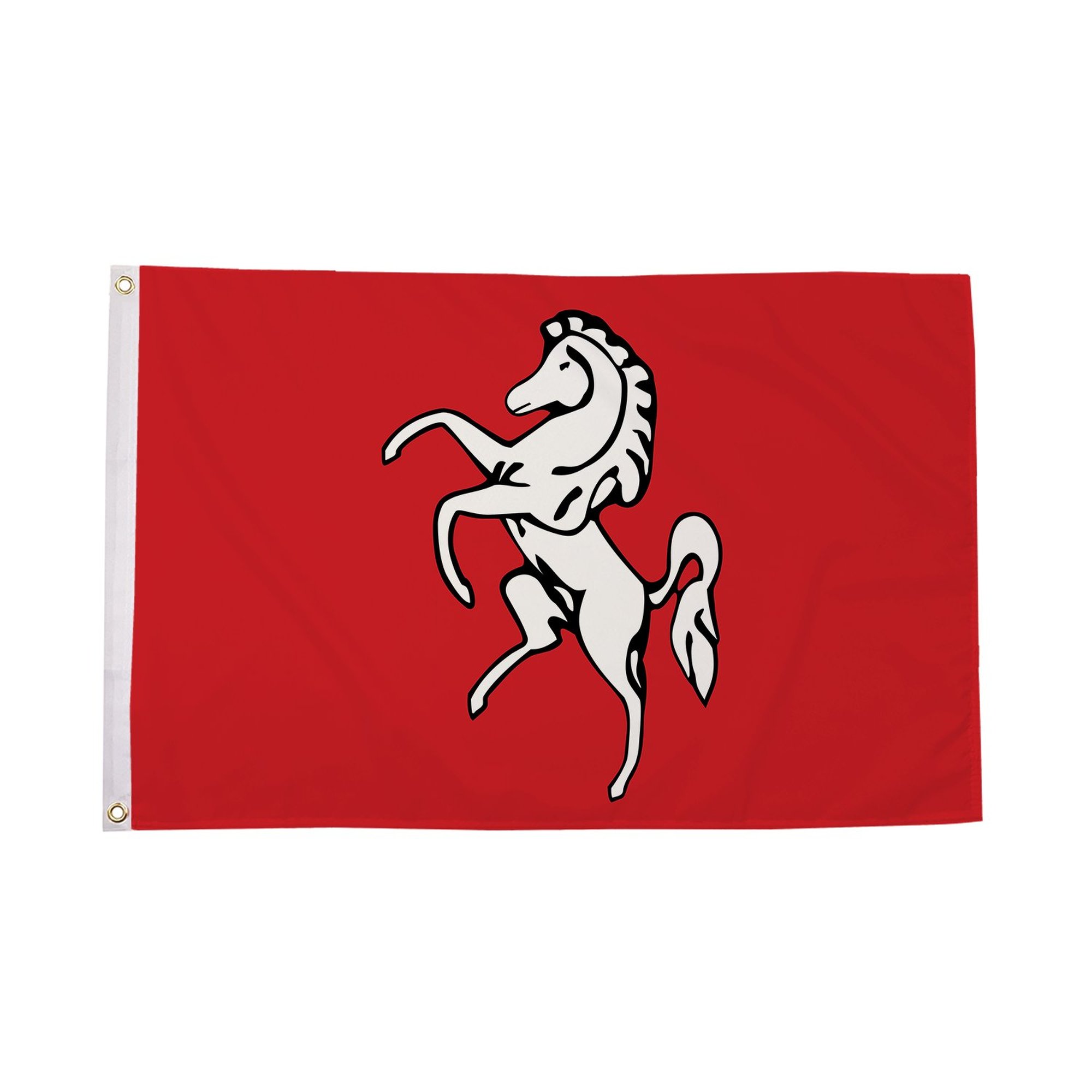
The white horse of Kent is one of the best-known county emblems in England, and the red flag that carries it is often said to go back to Hengist and Horsa. The documented history is shorter and more interesting: the horse was first linked in print with Kent's legendary founders in 1605, became the county's symbol in the eighteenth century, and was first officially recognised only in 1933.
Quick answer: the Kent flag, also called the Invicta Flag, is a white rearing horse on a red field. The Flag Institute registers it as Kent's traditional county flag, first recorded in 1605. It is the banner of the arms granted to Kent County Council on 17 October 1933.
The design
The Flag Institute's UK Flag Registry lists the Kent flag, or Invicta Flag, as a county flag of unknown designer, adopted by the "traditional" route, dated to the 17th century, in the proportions 3:5 and the colours white and Pantone Red 186. It notes that the flag is "supposedly based on that of Horsa, the Jute" and that "the first recorded reference is in 1605". [1]
The flag is a banner of the arms of Kent County Council, blazoned "Gules a Horse forcene Argent", a white horse rearing on a red field. The council's motto is INVICTA, "unconquered". [2]
Verstegan, Speed and the kings of Kent
In a 2017 study in Archaeologia Cantiana, the journal of the Kent Archaeological Society, the historian James Lloyd traced the symbol's documented history. [3] The leaping white horse on red was first linked to Kent by Richard Verstegan in A Restitution of Decayed Intelligence (1605), who illustrated "the banner or ensigne" of Hengist and Horsa and described Hengist's arms as "A horse argent rampant in a feild gules". In 1611 John Speed used the motif in his atlas Theatrum Imperii Magnae Britanniae, including an escutcheon labelled "Kentish Saxons", and cited Verstegan as his authority. [3]
These were arms attributed after the fact to the long-vanished kings of Kent, not arms of the county. Speed's own map of contemporary Kent does not show the horse, and Lloyd concludes that the symbol, invented in Germany in 1361, was "not applied to the kings of Kent until the early seventeenth century". [3] He also found that, even at the end of the eighteenth century, the county's officials did not use it, but sealed public business with their own personal seals; the Justices of the Peace's certificates of 1796-7, for example, carry their personal seals. [3]
The Hanoverian horse
The horse became Kent's own emblem in the eighteenth century. The Kentish Post, founded in 1717, added a white horse shield to its masthead some time between 1722 and 1726, the earliest known use of the motif as a symbol of the modern county. [3] Lloyd links this to the accession in 1714 of George I, whose Hanoverian arms included a similar horse, and whose electorate's flag was "almost identical" to today's Kent flag. A 1751 Royal Warrant put the Horse of Hanover on grenadiers' caps, and the East Kent Militia adapted it to show the horse leaping, as in the arms attributed to Hengist. [3]
By the nineteenth century the horse was everywhere in Kent. The Kent Insurance Company, founded in 1802, used it with the motto "Invicta", the first time the two appeared together. Kent County Council put it on its seal from its foundation in 1889, but the symbol had no official sanction until the council's grant of arms in 1933. [3] The arms were granted on 17 October 1933 [2] and re-confirmed in 1975. [4]
From cricket banner to county flag
The earliest reference to a flag is in an 1841 essay by Anne Pratt, who wrote of the men of Kent ranging themselves "beside their banner of the Horse rampant, bearing the bold motto INVICTA". The first organisation known to have flown a banner of the arms was Kent County Cricket Club, formed in 1870. [3] When the council was choosing its arms in 1931, Lord Harris, the club's founding captain and chairman of the County Arms Sub-Committee, argued against a blue background because red showed up better on a flag in poor weather. As late as 1952 the flag was still thought of as the cricket club's. [3]
Flag flying today
Kent County Council's flag-flying protocol, approved on 15 May 2013, states that the Union Flag and the Kentish Flag "are shown at full mast all year round at County Hall". For formal visits by other authorities or royal visitors, the Union and Kentish flags fly together with the visitor's flag where appropriate. [5]
Fly the Kent flag
Midland Flags sells the Kent flag in a range of sizes.
Sources
- The Flag Institute, "Kent", UK Flag Registry.
- Civic Heraldry of England and Wales, "South East Region": Kent County Council.
- James Lloyd, "The Saxon Steed and the White Horse of Kent", Archaeologia Cantiana, vol. 138 (2017), Kent Archaeological Society.
- Flags of the World, "Kent (England)", last modified 11 March 2023.
- Kent County Council, "Protocol for Flag Flying at County Council Buildings", approved by the Selection and Members Services Committee, 15 May 2013.