European Union
 Confederate
 Rainbow
 Other Pride
 Red Ensign
 RAF Ensign
 Yorkshire
 Cornwall
 Union Jack
 England
 Scotland
 Wales
 USA
 Ireland
 France
 Germany
 Italy
 Australia

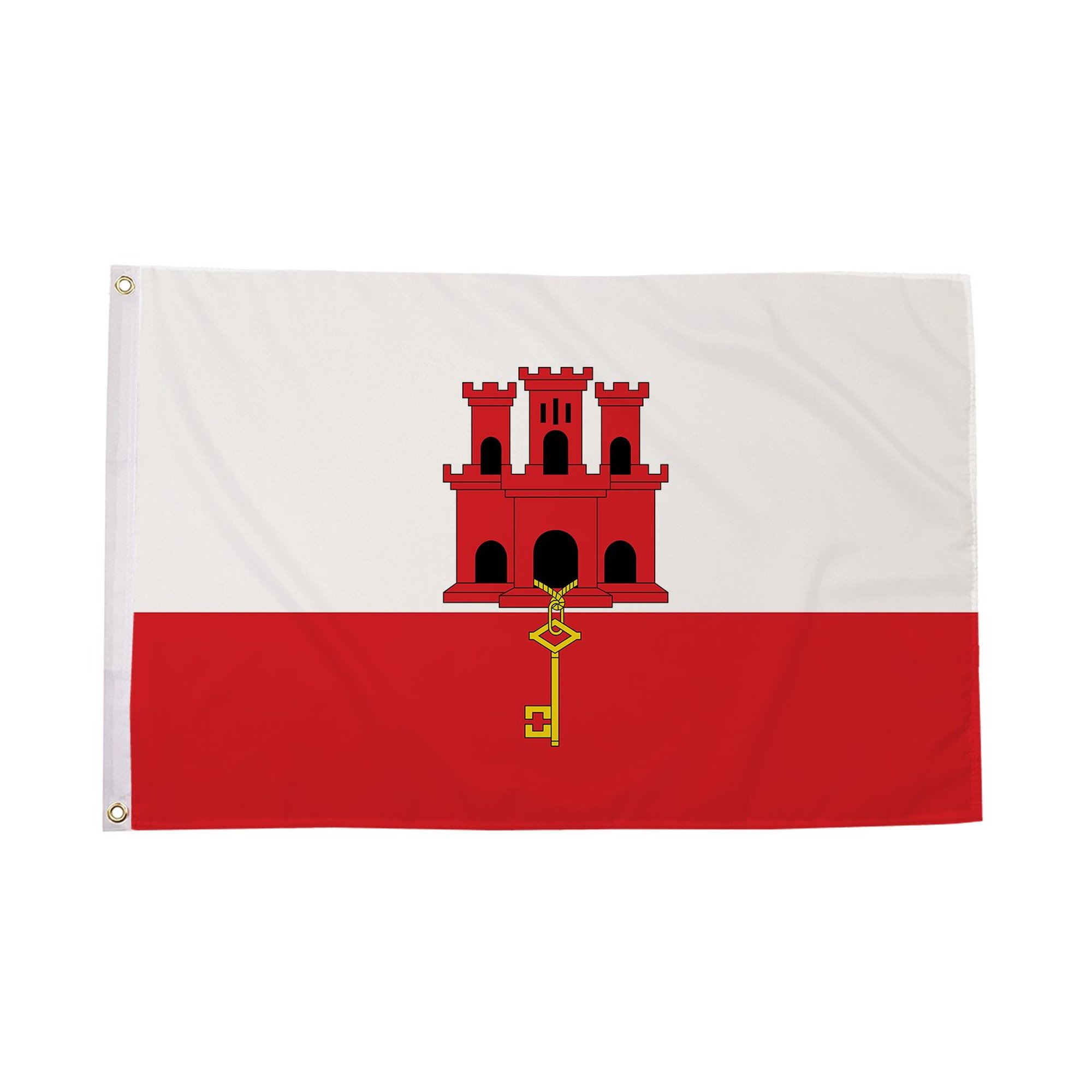
The flag of Gibraltar is unusual among the flags of British Overseas Territories. It is not an ensign and has no Union Flag in the corner. It is a banner of the territory's coat of arms, a red castle and a golden key, and it is older in origin than British Gibraltar itself.
Quick answer: the flag of Gibraltar is white over red, with a red three-towered castle on the white and a gold key hanging from the castle gate onto the red. It is an elongated banner of the arms granted to Gibraltar in 1502, and it was formally established as Gibraltar's flag on 8 November 1982.
The design
The Government of Gibraltar describes the flag as "an elongated banner of the arms of Gibraltar", granted by Royal Warrant from Queen Isabella of Castile on 10 July 1502. The grant describes "an escutcheon on which the upper two thirds shall be a white field and on the said field set a red castle", with the lower third red, a white line between the castle and the red field, and "a golden key which hangs by a chain from the said castle". [1]
On the flag this becomes two horizontal bands, white (double width) over red, with the castle in the white and the key in the red. In 2003 the Government of Gibraltar's Tercentenary Events Director gave the red as Pantone 485 C and the gold (amber) as Pantone 143 C. [1]
The coat of arms behind it
The arms, a triple-towered castle with a golden key, were granted to "The Most Loyal City of Gibraltar" by Ferdinand and Isabella in 1502, and the original grant on vellum is now held in the archives of the Municipality of San Roque in Spain. The words often found beneath the arms, Montis Insignia Calpe ("badge of the Rock of Gibraltar"), also appeared on the colours of the Suffolk Regiment, in recognition of its part in the Siege of Gibraltar. [1]
For many years the colony's seal showed a different device, the Rock with a sailing ship and the words Nulli Expugnabilis Hosti ("conquered by no enemy"). In a despatch of September 1926 Sir Charles Monro recommended that the 1502 arms be treated as the true arms of Gibraltar, and the Garter King of Arms advised that they could be recognised without a new Royal Warrant. [1]
From traditional flag to official flag
According to notes by the vexillologist William Crampton, the castle-and-key flag was officially introduced in 1966, but had been in traditional use "for as long as anyone could remember". It was formally established on 8 November 1982 "for internal purposes and for continued use abroad, together with the Union Flag, on appropriate occasions when the specific identity of Gibraltar is being represented". Before that, the official flag of the colony had been its Blue Ensign. [1]
How the flag is flown
National Day
The flag is at its most visible on Gibraltar National Day, 10 September. Ahead of National Day 2014 the Government of Gibraltar announced that the Care Agency was "hanging Gibraltar flags from the Mount Alvernia balconies". [2] Reporting on the 2015 celebrations, the Olive Press described Main Street with red and white bunting hanging from the windows and crowds dressed in red and white. [3] In 2020, when celebrations were scaled back during the Covid-19 pandemic, the same paper noted that there were fewer flags on balconies than in previous years. [4]
In London
The flag has also been flown by UK government departments to mark National Day. On 10 September 2013 the Department for Communities and Local Government flew it outside its offices, with the Foreign Office also flying it; Gibraltar's Chief Minister, Fabian Picardo, said it filled Gibraltarians "with joy and huge pride" to see the flag fly in London. [5] On 10 September 2019 the Foreign and Commonwealth Office again flew the flag of Gibraltar for National Day. [6]
Alongside other flags
In May 2017 the Chief Minister said Gibraltar would switch the EU flag for the Commonwealth flag after Brexit. [7]
The Lego flag
A large Gibraltar flag built from Lego bricks stood for years at the entrance to the John Mackintosh Hall. In April 2016 the Government of Gibraltar announced that it was being dismantled and moved to the foyer of the Cruise Terminal, where arriving cruise passengers enter the building, with reassembly planned by the end of May 2016. The government gave its measurements as 384 cm high, 360 cm long and 130 cm wide, and the Minister for Tourism called it a way to give "much more exposure to the Rock's most important symbol". [8]
Fly the Gibraltar flag
Midland Flags sells the Gibraltar flag in a range of sizes.
Sources
- Flags of the World, "Gibraltar (British Overseas Territory, United Kingdom)", last modified 9 November 2024 (quoting the Government of Gibraltar website and William Crampton's notes).
- HM Government of Gibraltar, "Mount Alvernia gets ready for National Day", Press Release 465/2014, 8 September 2014.
- The Olive Press, "Gibraltar National Day: A raucous celebration like no other", Tom Powell, 17 September 2015.
- The Olive Press, "Chief Minister promises to respect Gibraltar desire to be British in National Day message", John Culatto, 10 September 2020.
- GOV.UK, "Eric Pickles shows support for Gibraltar as flag flies high in Whitehall", 10 September 2013.
- GOV.UK, "Foreign Office to fly Gibraltar flag on National Day as FCO minister visits the Rock", 10 September 2019.
- MercoPress, "Gibraltar will switch the EU flag for Commonwealth flag after Brexit", 24 May 2017.
- HM Government of Gibraltar, "Gibraltar Lego flag to become new feature at Cruise Terminal", Press Release 202/2016, 26 April 2016.