European Union
 Confederate
 Rainbow
 Other Pride
 Red Ensign
 RAF Ensign
 Yorkshire
 Cornwall
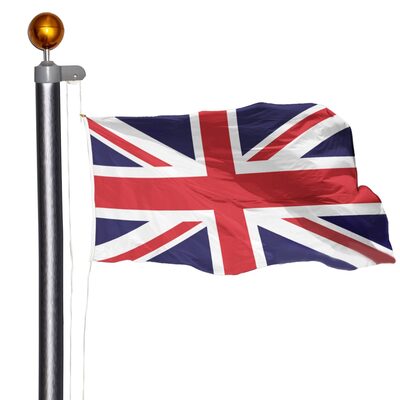
 Union Jack
 England
 Scotland
 Wales
 USA
 Ireland
 France
 Germany
 Italy
 Australia


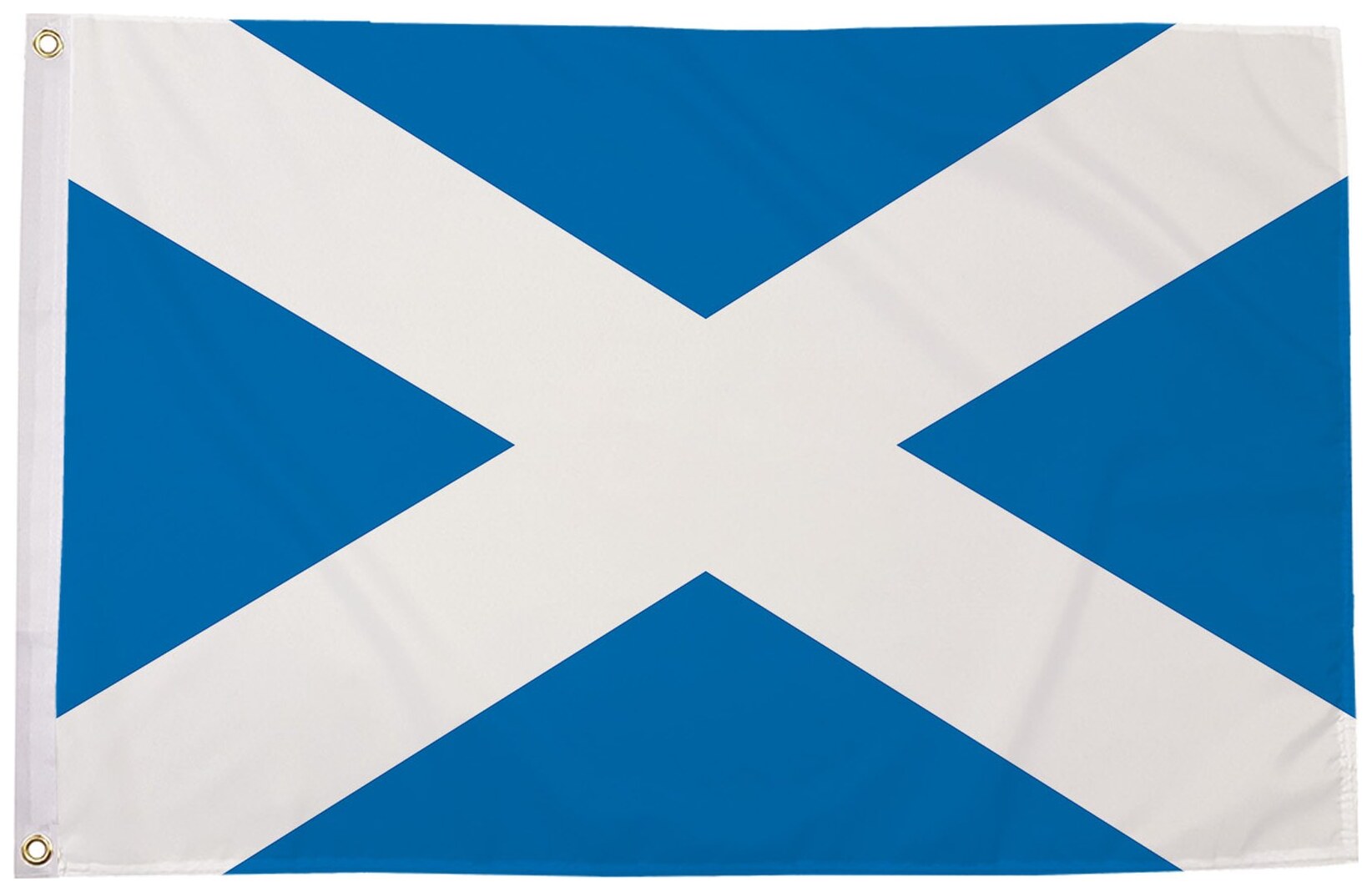
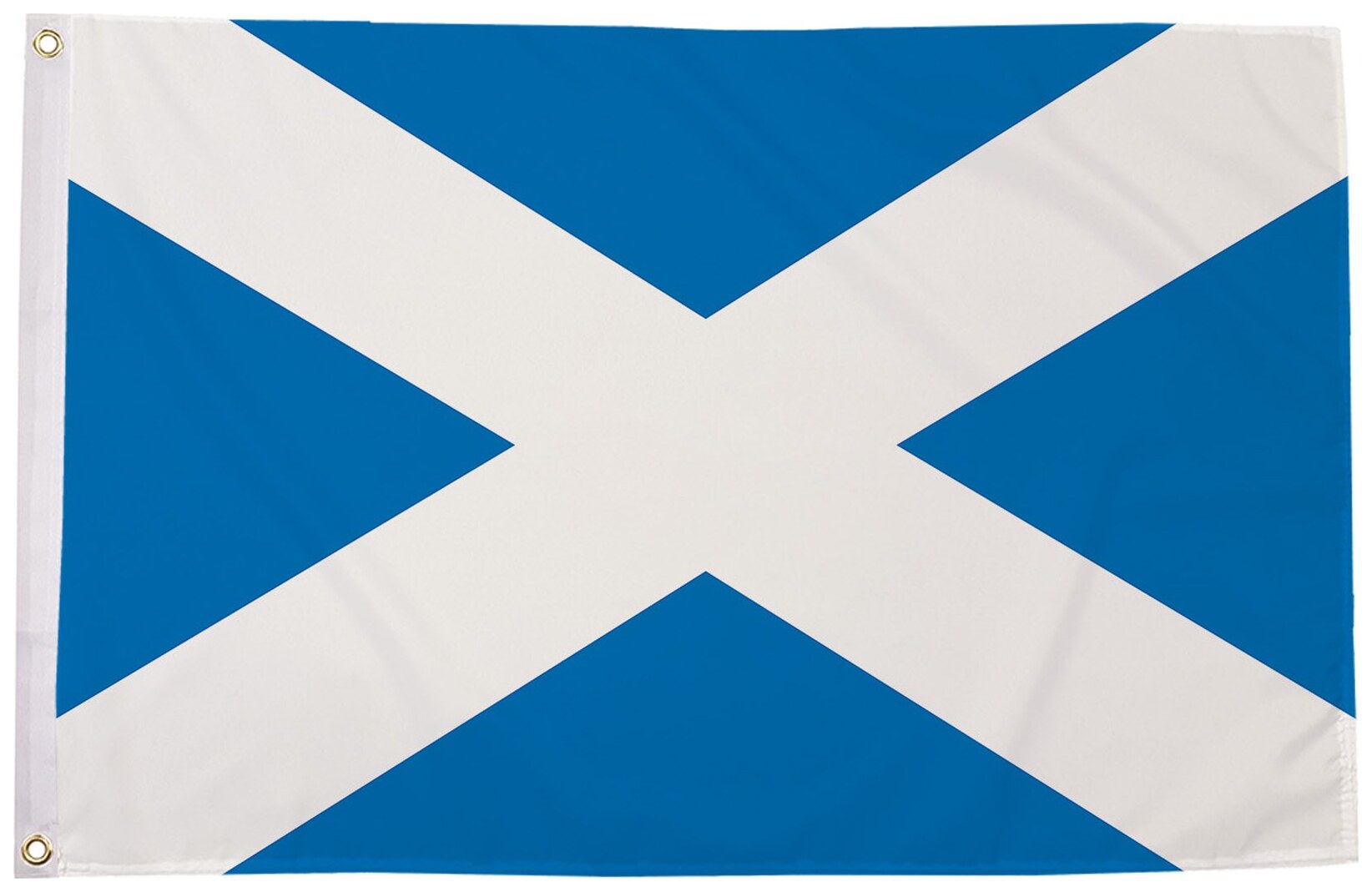
St Andrew's Day is Scotland's national day, celebrated every year on 30 November in honour of the country's patron saint. The simplest way to mark it is to fly the Saltire, the white diagonal cross on a blue field, and to dress your home, school or venue with Scotland bunting and table flags for a ceilidh or Scottish supper. Since 2007 it has also been a bank holiday in Scotland.
Who was St Andrew?
Andrew was a fisherman from Galilee and, according to the Gospels, one of the first disciples of Jesus, alongside his brother Simon Peter. Christian tradition holds that he was martyred at Patras in Greece, and from the medieval period onwards he was said to have been bound to an X-shaped cross because he felt unworthy to die on the same shape of cross as Christ. That diagonal cross, the saltire, became his emblem.
Andrew never visited Scotland, but relics said to be his were believed to have been brought to the east coast of Fife, where the town of St Andrews grew up around the cathedral. By the Middle Ages he was firmly established as Scotland's patron saint, and the Declaration of Arbroath of 1320 names him as the country's protector.
The legend of the Saltire
The best-known story of the flag's origin is set near the East Lothian village of Athelstaneford. According to the legend, a Pictish king, usually named as Óengus (Angus), was facing a larger army of Angles. The night before the battle he prayed for help, and on the day a white X of clouds appeared against a blue sky. The Picts won and adopted the white saltire on blue as their emblem. The date is usually given as 832, though versions differ and historians treat the story as legend rather than record. A Saltire flies permanently at the Scottish Flag Heritage Centre in Athelstaneford.
Is St Andrew's Day a bank holiday?
Yes, in Scotland. The St Andrew's Day Bank Holiday (Scotland) Act 2007 made 30 November a bank holiday, moving to the following Monday when the date falls at a weekend. It is not an automatic day off, though. Whether staff get the day is up to each employer, and many Scottish businesses and schools stay open. In England, Wales and Northern Ireland it is an ordinary working day.
It is also a designated flag-flying day. The UK Government lists 30 November as a flag day for government buildings in Scotland, and the Scottish Government's own guidance has the Saltire flown on its buildings on St Andrew's Day. Anyone may follow the same lead at home or at work.
Light blue or navy Saltire?
You will see the Saltire in two shades. Older flags often used a dark navy blue, close to the blue of the Union Flag. Today most official and public bodies use a brighter mid-blue: the Flag Institute recommended Pantone 300 in 1998, and a Scottish Parliament committee later backed the same shade. Neither shade is wrong for a private flag, and we stock the Scotland flag in both light blue and navy so you can match existing flags or club colours. For a full comparison of the Saltire and the Lion Rampant, see our guide to which Scottish flag you can fly.
Ways to celebrate with flags
| Occasion | What works well |
|---|---|
| Flagpole at home or work | A 5ft x 3ft Saltire suits most 15–20ft poles; choose DuraFlag if it will stay up all winter |
| Ceilidh or St Andrew's night dinner | Saltire bunting along walls and the stage, a table flag on every table |
| Schools and nurseries | 9in x 6in hand flags for assemblies and parades, bunting in the hall |
| Pubs, clubs and hotels | An 8ft x 5ft flag on the frontage, 9m bunting runs inside |
| Shop windows and offices | Desk or table flags, a short 3m run of bunting |
For a ceilidh, measure the walls you want to dress and allow roughly 10–15% extra for the natural dip between fixing points. Our Scotland bunting comes in 3m and 9m lengths, so a typical village hall usually needs two or three 9m runs. St Andrew's table flags on each table finish the room, and satin versions suit a formal dinner.
Late November is wet and windy across most of Scotland. A lightweight printed flag is fine for a day or a weekend, but if your Saltire will fly through the winter, a St Andrew's DuraFlag with its reinforced header and fly end will last much longer. Our guide to what size flag suits your flagpole helps you choose the right size.
Frequently asked questions
When is St Andrew's Day?
Every year on 30 November. When it falls on a Saturday or Sunday, the Scottish bank holiday moves to the following Monday, but the day itself is still celebrated on the 30th.
Can I fly the Saltire in England or Wales?
Yes. The Saltire is a national flag that anyone may fly, wherever they live. Many Scots living elsewhere in the UK fly it on St Andrew's Day and Burns Night.
Which way up does the Saltire go?
Unlike the Union Flag, the Saltire is symmetrical, so it cannot be flown upside down. Just make sure the header (the edge with the rope or eyelets) is against the pole.
What else can I celebrate with the same flags?
The same Saltire bunting and table flags work for Burns Night on 25 January, Hogmanay, Six Nations matches and Scottish football and rugby fixtures.
Planning your celebrations? Browse our St Andrew's Day flags and decorations, including Saltire flags in both shades, bunting, hand flags and table flags.