European Union
 Confederate
 Rainbow
 Other Pride
 Red Ensign
 RAF Ensign
 Yorkshire
 Cornwall
 Union Jack
 England
 Scotland
 Wales
 USA
 Ireland
 France
 Germany
 Italy
 Australia

There is no fixed answer to how long a flag lasts outside, because wind, sunlight, coastal air and how many hours it flies all make a big difference. As a rough guide, a lightweight knitted flag flown continuously might last around three to six months, while heavier fabrics often manage six to twelve months or more. Fly it in daylight only, take it down in strong winds and look after the fly end, and you will get noticeably more from it.
Quick answer: treat any lifespan figure as a rough guide, not a promise. Heavier fabric, daytime-only flying, a smooth pole and prompt repairs at the fly end are the things that extend a flag's life most.
What wears a flag out
Every flag flown outdoors is slowly worn away by the weather. As our own product notes put it, there is no such thing as a permanent outdoor solution, as flags will of course eventually wear when up against the elements. Understanding what causes the wear helps you slow it down.
Wind
Wind is the biggest single factor. Each time the flag cracks and snaps in a gust, the fibres at the free end (the fly) are whipped against each other and against the air. This is why fraying almost always starts at the fly end and works inwards. A sheltered garden pole will see far less wear than an exposed hilltop or a rooftop.
Sun and UV
Sunlight gradually breaks down both the dye and the fabric itself. Strong colours such as reds and blues fade over time, and fabric weakened by UV tears more easily in the wind. South-facing, unshaded sites see the most fading.
Coastal air
Salt in the air, combined with stronger and more constant winds near the sea, shortens a flag's life considerably. If you fly a flag on the coast, expect to replace it more often than you would inland, and consider sizing down slightly so the flag is under less strain.
Flying around the clock
Flying a flag 24 hours a day, seven days a week greatly shortens its life compared with flying it in daylight only. A flag that comes down every evening may simply be exposed to half the wind and weather of one that never comes down.
Pole condition and snag points
A rough or damaged pole, a loose halyard, a sharp bracket edge or nearby branches can all catch the fabric and start a tear. Check that the pole is smooth, the fittings are secure and that the flag cannot wrap itself around anything as it flies. A small snag point can ruin a new flag in days.
Fabric weight and construction
Heavier fabric and stronger stitching resist fraying for longer. Our DuraFlag range is made from 150gsm knitted polyester, which is around 50% heavier and of a higher quality than the industry standard 115gsm. Each DuraFlag has double-sewn edges, four rows of stitching on the fly end and a reinforced header, so it is built for outdoor flying. Our standard woven polyester flags are described as suitable for indoor or occasional outdoor use, which makes them a cost-effective choice for events and short spells outside rather than continuous flying.
Rough guide to outdoor flag life by fabric
The figures below are typical ranges quoted across the flag industry for continuous outdoor flying. They are a rough guide only. Your own results will depend heavily on wind, sun, coastal air and whether the flag flies 24/7.
| Fabric | Best suited to | Rough guide (continuous outdoor flying) |
|---|---|---|
| Standard woven polyester (our Flagtex range) | Indoor or occasional outdoor use, events, short spells outside | Not intended for continuous flying |
| Lightweight knitted polyester (about 115gsm) | General outdoor flying | Roughly 3 to 6 months |
| Heavier knitted polyester (such as our 150gsm DuraFlag) | Regular outdoor flying, including more exposed sites | Roughly 6 to 12 months or more |
For a fuller comparison of materials, see our guide to DuraFlag vs polyester vs nylon flags.
Signs it is time to replace your flag
- Fraying at the fly end. Loose threads and a ragged edge at the free end are the first sign of wear. Caught early, this can be trimmed and re-hemmed. Left alone, it spreads quickly.
- Fading. When the colours look washed out, particularly on a national flag, the flag no longer looks its best and the fabric has usually been weakened by UV as well.
- Holes and tears. Small holes in the body of the flag tend to grow in the wind. Once the fabric is splitting away from the stitching, or the header is damaged, it is time for a new one.
- Damaged fittings. A torn eyelet, a worn rope or a loose toggle can let the flag come free in a gust.
A national flag in poor condition does not show it the respect it deserves, so most flyers replace a flag once it looks tired rather than flying it until it falls apart.
How to make your flag last longer
Take it down in strong winds
UK flag makers commonly advise taking flags down when winds rise above about 31 mph (Beaufort force 6). A single stormy night can do more damage than weeks of normal flying, so keep an eye on the forecast.
Fly in daylight
Traditionally, flags are flown from sunrise to sunset anyway. Bringing yours in each evening, or at least on rough nights, cuts its exposure dramatically.
Rotate two flags
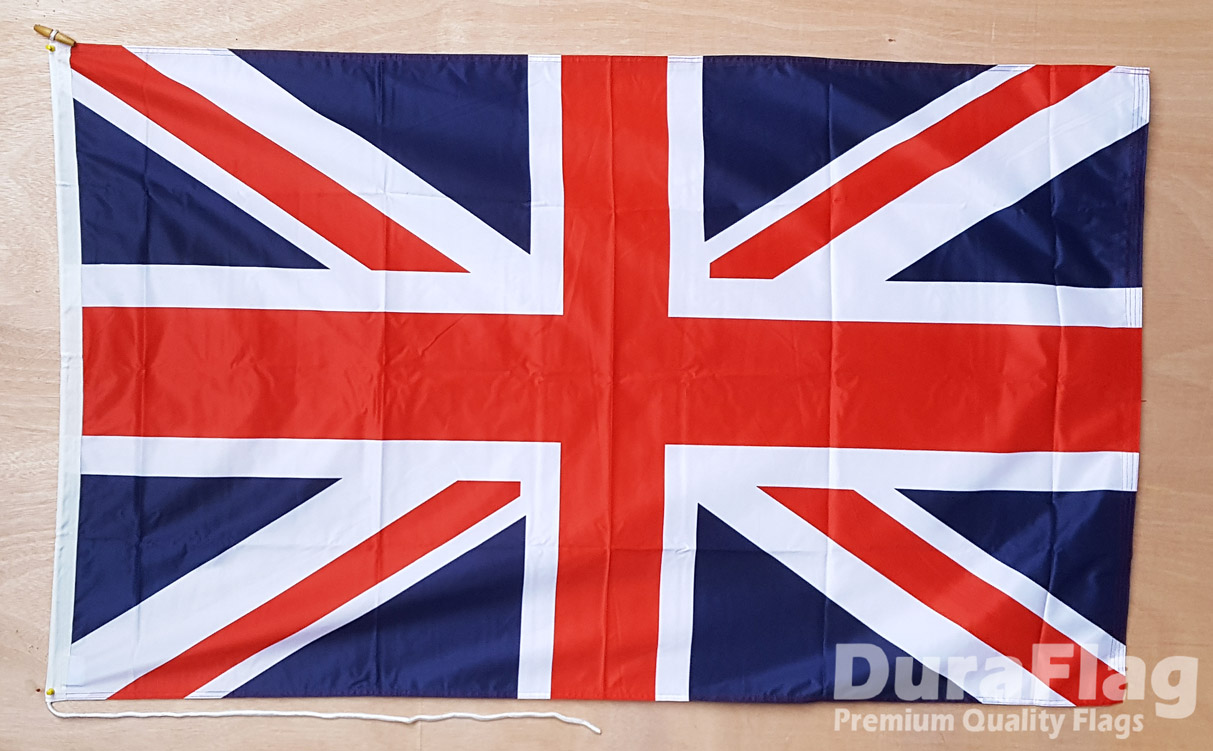
Owning two flags and swapping them over means each one gets a rest, a chance to be cleaned and dried, and time for any small repairs. It also means you always have a flag ready to fly while the other is being looked after. A pair of our Union Jack DuraFlags is a popular choice for this.
Trim and re-hem at the first sign of fraying
Because wear starts at the fly end, trimming off the frayed edge and sewing a new hem as soon as you notice it stops the damage spreading. The flag ends up very slightly shorter, but it will carry on flying for much longer.
Keep it clean and dry
Dirt and grime held in the fabric add to wear, and a flag put away damp can develop mildew. Our guide on how to wash and care for a flag covers washing, drying and storing.
Disposing of an old flag respectfully
When a flag is worn out, the respectful way to dispose of it is to cut it into strips so that it no longer resembles the flag, then dispose of the pieces. Avoid burning polyester flags, as burning polyester gives off harmful fumes.
Frequently asked questions
How long does a flag last outside?
As a rough guide, lightweight knitted flags last around three to six months of continuous outdoor flying and heavier fabrics six to twelve months or more. Wind, sun, coastal air and 24/7 flying can shorten this considerably.
Is there such a thing as a permanent outdoor flag?
No. All flags eventually wear when up against the elements. Heavier fabric and stronger stitching, like those used on DuraFlags, simply slow the process down.
Why does my flag fray at the end first?
The fly end moves the most in the wind, so its fibres take the most punishment. That is why DuraFlags have four rows of stitching on the fly end, and why trimming and re-hemming early makes such a difference.
Should I take my flag down at night?
You do not have to, but flying in daylight only greatly extends a flag's life. If you fly at night, the convention is that the flag should be lit.
Can I use a standard polyester flag outdoors?
Yes, for occasional outdoor use such as a celebration or event. For a flag that will fly outside week after week, a heavier fabric is the better choice.
If your current flag is looking tired, browse our DuraFlag range for outdoor flying, or explore our full collection of flags for every country, county and occasion.