England
 Scotland
 Wales
 USA
 France
 Germany
 Spain
 Italy
 Australia
 European Union
 Confederate
 Rainbow
 Other Pride
 Red Ensign
 RAF Ensign
 Yorkshire
 Cornwall
 Union Jack
 Ireland




Diwali decorations are all about light and colour: rows of small clay lamps (diyas), rangoli patterns at the doorway, strings of lights and bright marigold shades of orange, yellow, pink and red. Diwali, or Deepavali, is the festival of lights, celebrated in October or November by Hindus, Sikhs, Jains and some Buddhists. This guide covers what the festival means, when it falls, and how homes, schools and workplaces can decorate thoughtfully and safely.
When is Diwali?
Diwali follows the Hindu lunisolar calendar, with the main day on the new moon night in the month of Kartik, so the date moves each year. The festival usually runs over five days, with Lakshmi Puja on the main day. The dates below are the main Diwali day as commonly listed; temples and families sometimes observe it a day apart depending on the calendar they follow, so check with your local mandir.
| Year | Main day of Diwali |
|---|---|
| 2026 | Sunday 8 November |
| 2027 | Friday 29 October |
| 2028 | Tuesday 17 October |
| 2029 | Monday 5 November |
| 2030 | Saturday 26 October |
What Diwali celebrates
The common thread is the victory of light over darkness, and the festival carries different meanings for different communities:
- Hindus remember the return of Lord Rama to Ayodhya after defeating Ravana, when the city lit lamps to welcome him. Lakshmi, the goddess of wealth and good fortune, is worshipped on the main night, and in parts of India the festival recalls Krishna's defeat of the demon Narakasura.
- Sikhs celebrate Bandi Chhor Divas, the release of the sixth Guru, Guru Hargobind, from imprisonment in Gwalior Fort, along with 52 princes. The Golden Temple in Amritsar is famously illuminated.
- Jains mark the nirvana of Lord Mahavira.
- Some Buddhists, particularly Newar Buddhists in Nepal, also celebrate.
Diwali is celebrated well beyond India: in Nepal (as Tihar), Sri Lanka, Mauritius, Fiji, Trinidad and Tobago, Guyana and across the diaspora. When decorating for a mixed group, it is better not to assume that everyone celebrating has Indian heritage.
Traditional Diwali decorations
- Diyas: small clay lamps filled with oil or ghee, placed on doorsteps, windowsills and around the home.
- Rangoli: patterns made on the floor at the entrance from coloured powder, rice, sand or flower petals, to welcome guests and Lakshmi.
- Toran: hangings of marigolds and mango leaves across the doorway.
- Lights and lanterns: fairy lights outlining windows and balconies, and hanging paper lanterns (akash kandil).
- Sweets and gifts: boxes of mithai shared with family, neighbours and colleagues, plus new clothes and fireworks.
Decorating a school, office or community hall
For a shared space, the aim is warmth and colour that everyone can enjoy, with sacred symbols used only where they belong.
Colourful bunting is the easiest way to transform a hall or classroom. Single-colour runs in saffron, yellow, pink and red, alternated across the ceiling, echo marigold garlands. Choose from our plain colour bunting or a ready-mixed multi-coloured triangle bunting. For a typical classroom, two 9m lengths draped corner to corner give a full look; our bunting buying guide explains how to measure for larger rooms, and how to hang bunting covers fixing it without damaging walls.
The India flag suits an event that celebrates Indian heritage specifically, such as a cultural evening or an Indian society's Diwali dinner. Our India flags come in sizes from hand flags to 8ft x 5ft. For a wider community event, consider the flags of all the countries your guests come from instead.
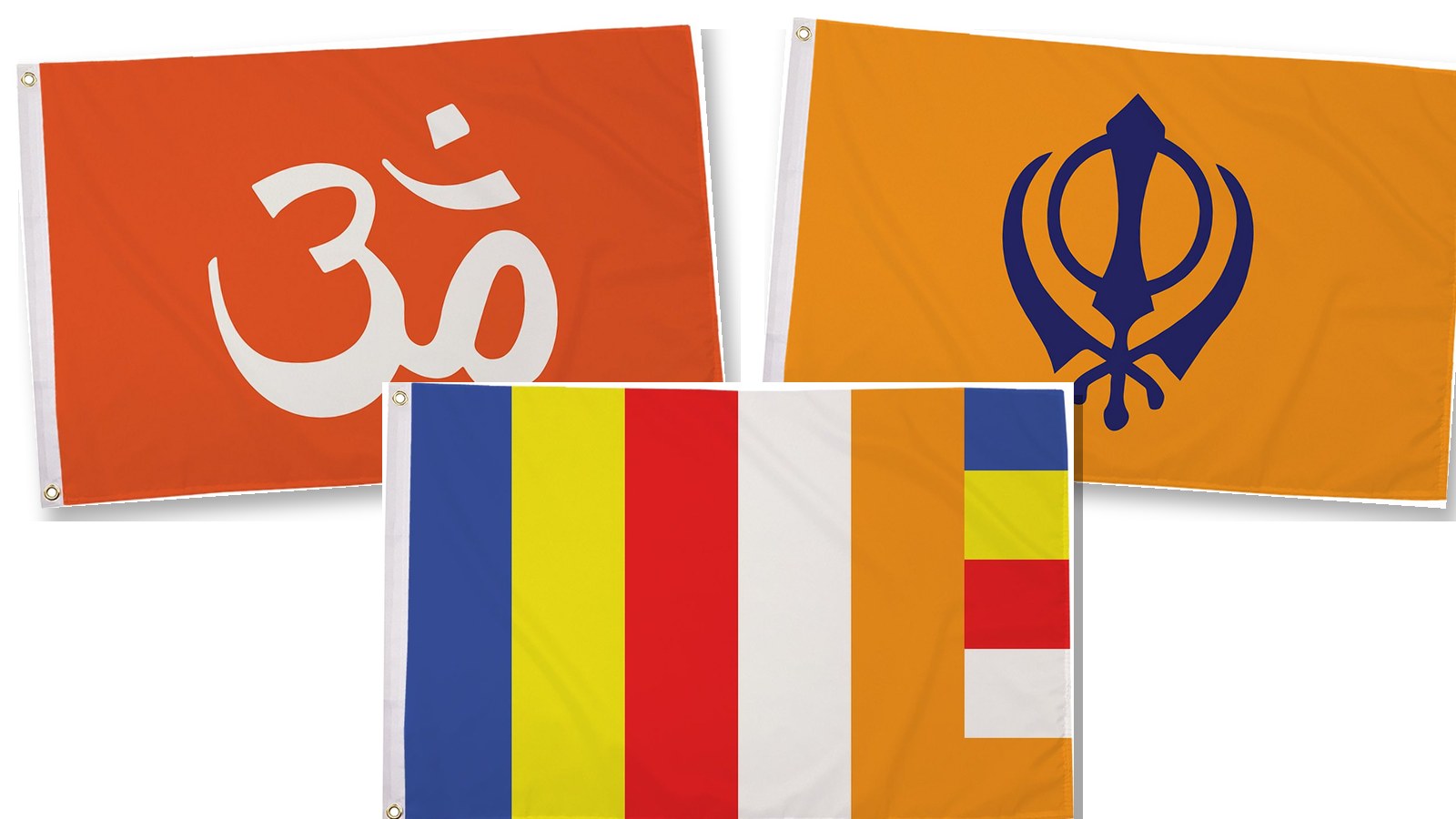
The Hindu flag we sell is a saffron flag with the sacred Om symbol in white. Om is one of the most holy symbols in Hinduism, so this flag belongs at a mandir, a puja, a Hindu society event or at home, displayed upright, kept off the floor and never used as a tablecloth or fancy-dress item. It is not the right choice for a general office party. You can find it, with the Sikh flag for Bandi Chhor Divas, in our religious flags range; the Hindu flag comes in standard printed sizes.
Fire safety: diyas, candles and fabric
Flags and bunting are made of polyester, which melts and burns if it meets a flame. A few rules keep the festival safe:
- Keep diyas, tea lights and candles well clear of bunting, flags, curtains and garlands, and never hang bunting directly above a row of lamps.
- In schools, offices and care homes, use battery LED diyas; many workplaces do not permit naked flames at all.
- Place real diyas on a non-flammable surface, out of reach of children and away from doorways where clothing can brush past.
- In England and Wales, fireworks may be set off until 1am on the night of Diwali, rather than the usual 11pm. Be considerate of neighbours and pets, as Diwali can fall close to Bonfire Night.
For autumn events that overlap, our guide to Halloween and Bonfire Night decorations has more seasonal ideas.
Diwali in the UK
Leicester's Belgrave Road, the Golden Mile, is widely described as hosting one of the biggest Diwali events outside India, with street lights and family celebrations, though the format has changed in recent years. London often holds a Diwali celebration in Trafalgar Square, and towns from Birmingham and Wolverhampton to Bradford and Southall hold their own. Check your council or local mandir for details each year.
Frequently asked questions
Is Diwali the same as Deepavali?
Yes. Deepavali means "row of lights" and is the name widely used in southern India, Singapore and Malaysia. Diwali is the more common form in northern India and the UK.
Do Sikhs celebrate Diwali?
Sikhs celebrate Bandi Chhor Divas on the same day, marking the release of Guru Hargobind from Gwalior Fort. Gurdwaras are lit up and many Sikh families light lamps at home.
What colours are used for Diwali decorations?
Warm, bright colours: saffron, marigold orange, yellow, red, pink and gold, plus plenty of light.
Can a school use the Om symbol in its Diwali display?
It can, with care. Display it respectfully and upright, explain its meaning, and ask Hindu families or a local mandir for guidance. Keep it away from craft activities where it might be cut up or thrown away.
Ready to decorate for Diwali? Start with our plain colour bunting for colourful halls and classrooms, or see the religious flags range for mandir and home use. Sikh readers may also enjoy our guide to Vaisakhi, and our national days calendar lists other dates through the year.