
 England
 Scotland
 Wales
 USA
 France
 Germany
 Spain
 Italy
 Australia
 European Union
 Confederate
 Rainbow
 Other Pride
 Red Ensign
 RAF Ensign
 Yorkshire
 Cornwall
 Union Jack
 Ireland

-
St Andrews (Light Blue) Flag
 Choose size →6 sizes · 3 qualities · 3 fittingsThe price depends on the options chosen on the product pagefromAs low as £5.99
-
St Andrews (Navy Blue) Flag
 Choose size →6 sizes · 3 qualities · 3 fittingsThe price depends on the options chosen on the product pagefromAs low as £6.98
-
Scotland Lion Flag
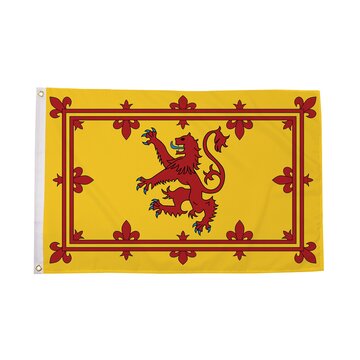 Choose size →5 sizes · 3 qualities · 2 fittingsThe price depends on the options chosen on the product pagefromAs low as £6.98
-
Bonnie Scotland Flag
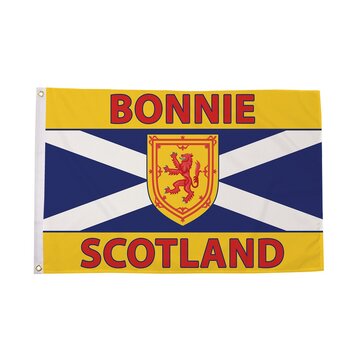 Choose size →5 sizes · 2 qualities · 2 fittingsThe price depends on the options chosen on the product pagefromAs low as £6.98
-
Orkney New Flag
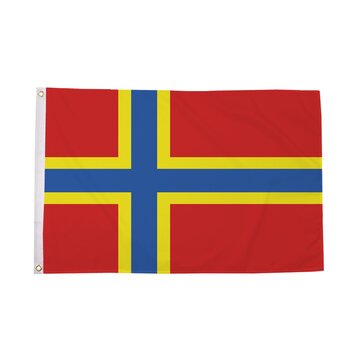 Choose size →5 sizes · 2 qualities · 2 fittingsThe price depends on the options chosen on the product pagefromAs low as £6.98


Shop Scotland in every format
Scotland flags: the Saltire, the Lion Rampant and the two blues
The flag of Scotland is called the Saltire, or St Andrew’s Cross: a white diagonal cross stretching corner to corner on a blue field, in a 3:5 proportion. The story behind it puts a white cross of cloud in a blue sky over a battlefield at Athelstaneford in East Lothian in 832 AD, and Scots have claimed it as the oldest national flag still in use ever since. The design was carried on Scottish ships and soldiers’ coats from the fourteenth century and went into the Union Flag of 1606 as the blue ground beneath the English cross.
The blue is the question we get asked most. Historically it ranged from sky blue to the deep navy of the Union Jack, and in 2003 the Scottish Parliament settled on Pantone 300, a shade between the two. We stock both: the navy blue Scotland flag, which matches a Union Jack hung beside it, and the light blue Scotland flag, the brighter shade seen at Hampden and Murrayfield.
The Lion Rampant and the old Scottish flags
The Scotland Lion flag, a red lion rampant inside a red double border on yellow, is the Royal Banner of Scotland and dates to William the Lion in the twelfth century. Strictly it belongs to the monarch and the Great Officers of State, which is why it is sometimes called the old Scottish flag, but it is waved freely at football and rugby and nobody has been prosecuted for it in living memory. The Scotland the Brave flag puts the lion on the Saltire for supporters who want both, and the Jacobite flag and Scottish Red Ensign cover the historical side.
When Scottish flags are flown
St Andrew’s Day on 30 November is the national day, when the Saltire goes up on every Scottish Government building and most schools hold a themed day. Burns Night on 25 January, Hogmanay, the Edinburgh Tattoo in August and the Highland games season through the summer all bring orders, and a Scotland qualification for a World Cup or Euros clears the shelves of car flags and bunting in a week.
Sizes, grades and fittings
5ft x 3ft is the standard for a garden pole, a pub or a B&B; 3ft x 2ft suits a window or a bothy wall; 8ft x 5ft is the size for a distillery, hotel or golf club flagpole. Flagtex is the printed polyester for a weekend, Flagtex Nylon the heavier cloth with a quadruple-stitched fly end for regular use, and the DuraFlag Saltire is the knitted, UV-fast, double-stitched grade for a pole that flies the flag every day, with rope and toggle or clips at the hoist.
Scotland bunting
Saltire bunting in navy or light blue runs from 3m to 20m in rectangle or triangle pennants, and Lion Rampant bunting adds a line of red and gold. It is printed on weatherproof polyester with a sewn tape, so it will see out a wet Highland games weekend.
Scotland hand flags, car flags, windsocks and table flags
Scotland hand flags on wooden sticks are the ones waved at Murrayfield and sent to schools for St Andrew’s Day. The Scotland car flag clips to a window for the drive to Hampden, and there is a Lion Rampant car flag too. A Saltire windsock suits a caravan or campsite pole, and the Scotland table flag with base sits on a Burns supper table or a hotel reception desk.
Scottish regional and island flags
Scotland’s regions are starting to register flags of their own and we stock those that have one: Aberdeenshire, Caithness, Kirkcudbrightshire, the Isle of Skye and the Western Isles, alongside the universities of Edinburgh, Glasgow and St Andrews and a Highland cow flag for the gift shop. England, Wales and the Union Jack each have their own hub in the British flags range.
Scottish flag FAQs
What is the Scottish flag called?
The Saltire, also known as St Andrew’s Cross. It is a white diagonal cross on a blue background and is the national flag of Scotland.
Should a Scotland flag be navy blue or light blue?
Either is correct. The Scottish Parliament recommends Pantone 300, a mid blue, but navy and sky blue are both in everyday use; choose navy to match a Union Jack and light blue for the brighter sporting look.
Is the Lion Rampant the flag of Scotland?
No. The Lion Rampant is the Royal Banner of Scotland, reserved in law for the monarch and their representatives. The national flag is the Saltire, though the lion is widely flown by supporters.
Why is the Saltire a diagonal cross?
St Andrew is said to have been crucified on an X-shaped cross, and the legend of 832 AD describes a white diagonal cross of cloud appearing in a blue sky before a Pictish victory.
What size Scotland flag suits a garden telescopic pole?
5ft x 3ft on a pole of 20ft or under. Go to 8ft x 5ft only on a fixed pole of 25ft or more, or the flag will foul the pole in a breeze.
Do you sell Scottish regional flags?
Yes: Aberdeenshire, Caithness, Kirkcudbrightshire, the Isle of Skye and the Western Isles, plus Scottish university flags, with more added as regions register their designs.